

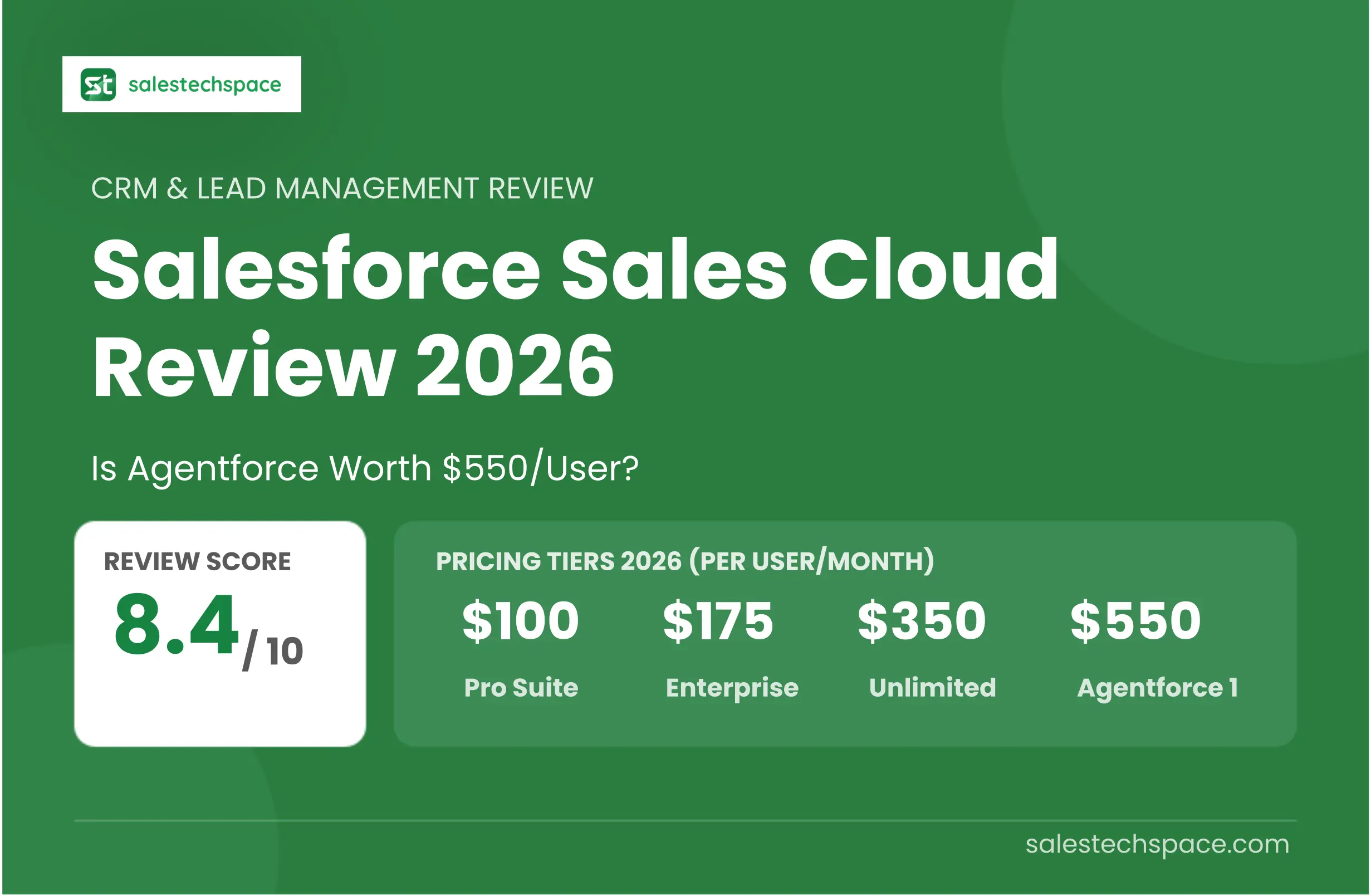
Salesforce rebranded Sales Cloud as Agentforce Sales in 2025. The pricing changed. The AI capabilities expanded. The enterprise sales motion intensified. And for the first time in seven years, list prices went up.
This Salesforce Sales Cloud review 2026 answers the only question that matters in 2026: with HubSpot Sales Hub, Attio, and Microsoft Dynamics all closing the gap, is Salesforce still worth the premium? As an enterprise CRM review, the honest answer is yes for genuine enterprise complexity and no for almost everyone else. This Salesforce Sales Cloud review 2026 covers the full picture: pricing at all four tiers, what Agentforce actually delivers, real total cost of ownership, and which teams should buy versus skip.
Quick Verdict
Score: 8.4 / 10 | Best for enterprises with 200+ sales reps, complex commercial models, regulated industries, or mature Salesforce expertise.
Real Year-1 total cost of ownership: $50,000 to $1,000,000+ depending on tier, edition mix, and implementation depth
Skip if: Under 50 reps, need fast time-to-value, or cannot fund a dedicated admin from day one.
What Is Salesforce Sales Cloud (Now Agentforce Sales)?
Salesforce Agentforce Sales is Salesforce’s renamed CRM tier, reflecting the company’s 2025 bet on agentic AI. Autonomous agents take actions inside the CRM rather than just suggesting them. The platform’s depth is unmatched: five sub-clouds, multi-org architecture, complex commission and territory management, 5,000+ AppExchange integrations, and the deepest customization layer of any CRM on the market.
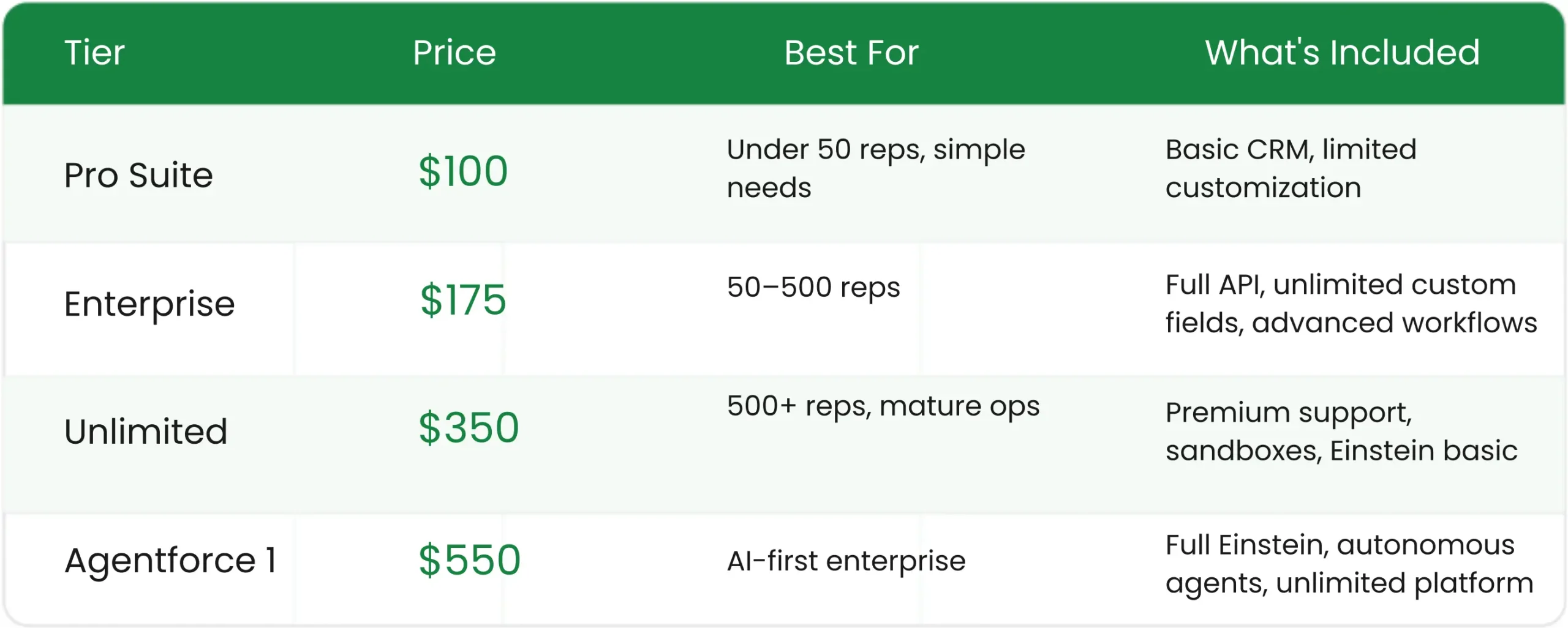
In 2026, Salesforce Agentforce Sales runs on four tiers:
- Pro Suite ($100/user/month): Entry-level enterprise CRM, limited customization
- Enterprise ($175/user/month): First tier with full API access; the realistic floor for serious Salesforce deployments
- Unlimited ($350/user/month): Premium support, full sandboxes, advanced features
- Agentforce 1 ($550/user/month): Full Einstein generative AI, autonomous agents, unlimited customization
The August 2025 6% across-the-board price increase (the first in seven years) added meaningful total cost of ownership pressure for renewing customers.
Salesforce Sales Cloud Pricing in 2026: Real Numbers
Salesforce publishes its tier pricing, but understanding real Salesforce pricing 2026 means looking past the sticker price. But for this Salesforce Sales Cloud review 2026, real-world total cost of ownership is what matters. Salesforce pricing 2026 at the headline rate is only a fraction of what organizations actually pay.
Tier Pricing (per user/month, billed annually)
The Implementation Reality
For a 200-rep team on Enterprise:
- License: $420,000/year
- Implementation: $126,000 to $168,000 (Year 1 only, 30-40% of license)
- Salesforce admin (full-time): ~$120,000/year
- Custom AppExchange apps: $20,000 to $80,000/year
- Service Cloud add-on (typical): $150/user/month = +$360,000/year
Realistic Year-1 TCO for a 200-rep Enterprise deployment: $1,000,000+
See A0008_inline_tco.svg: gap between $420K license-only and $1M+ real Year-1 TCO.
Hidden Cost Traps
- Cloud sprawl: Each Salesforce cloud (Sales, Service, Marketing, Commerce, Data) is priced separately. Costs compound fast.
- Edition gates: Critical features including workflow automation, advanced reporting, and full API access are gated behind higher editions.
- 3-year commits: Most Salesforce contracts are annual commit or 3-year with limited mid-term flexibility.
- Support tier gaps: Premium support is included in Unlimited and above. Enterprise tier customers pay extra.
- Sandbox costs: Full-copy sandboxes are an Unlimited-tier feature. Enterprise customers get smaller dev sandboxes.
What This Salesforce Sales Cloud Review 2026 Finds Genuinely Good
1. Customization Depth
Nothing in the CRM market matches Salesforce’s customization depth. Multi-org structures, complex commission and quota models, regulated industry compliance overlays, custom objects with full metadata control, declarative and code-based configuration. If you can describe a sales process, Salesforce can model it. This is the core reason 200+ rep enterprises with complex commercial models default to Salesforce over any alternative.
2. Salesforce Agentforce in 2026
Salesforce Agentforce delivers genuinely autonomous AI agents inside the CRM. The 2026 capabilities:
- Lead qualification agents: Score, route, and engage inbound leads automatically
- Meeting prep agents: Synthesize CRM history before every call
- Follow-up drafting agents: Write personalized post-meeting emails
- Deal risk agents: Flag at-risk opportunities and recommend interventions
- Pipeline review agents: Prep sales managers for QBRs and forecast calls
The catch: Salesforce Agentforce works best on the Agentforce 1 tier at $550/user/month. Lower tiers get partial functionality.
3. AppExchange Ecosystem
5,000+ third-party apps. Every major sales tech, marketing tech, RevOps tool, and industry vertical solution has a Salesforce integration. This ecosystem advantage is structural and hard for any competitor to replicate at the same depth.
4. CFO-Grade Forecasting
Salesforce forecasting holds up to CFO scrutiny in ways most CRMs cannot: multi-currency, multi-segment, weighted pipeline analysis, AI-driven forecast adjustments via Sales Cloud Einstein. For public companies and large privates that report quarterly numbers, this depth matters in ways that HubSpot’s reporting simply does not match.
5. Compliance and Industry Verticals
Sales Cloud Einstein and the broader platform carry the most-mature compliance posture in the CRM market: SOC 2, ISO 27001, FedRAMP, HIPAA, GDPR, and industry-specific certifications. Pre-built vertical solutions for financial services, healthcare, and manufacturing include vertical workflows out of the box.
Where Salesforce Sales Cloud Falls Short
- Total cost of ownership. The most expensive CRM by a wide margin. Real Year-1 TCO is typically 2.5x to 3x the license fee. For mid-market teams under 200 reps, this often makes Salesforce the wrong economic choice even when it is the best technical fit.
- Implementation complexity. Six-month Salesforce implementation timelines are the norm at Enterprise tier. Twelve to 18-month rollouts are standard for multi-cloud Unlimited deployments. Compare to HubSpot at 4 to 12 weeks and the time-to-value gap is significant.
- Admin dependency. You need a dedicated Salesforce admin. For teams under 50 reps, the admin cost often exceeds the license cost. Consultancy support runs $150 to $300 per hour.
- UX trails modern alternatives. Salesforce Lightning is functional. It is not beautiful. Compared to HubSpot, Attio, or Pipedrive, the experience feels enterprise-heavy. New rep onboarding takes weeks rather than days.
- Pricing opacity at enterprise. While headline tier pricing is published, real enterprise contracts involve volume discounts, edition mixing, and multi-cloud bundling only revealed during sales negotiations. Procurement teams regularly sign without full price clarity.
Salesforce Sales Cloud vs. Alternatives: 2026 Comparison
The Salesforce vs HubSpot question drives most mid-market CRM evaluations in 2026. This Salesforce Sales Cloud Review 2026 addresses it directly alongside the other primary alternatives:
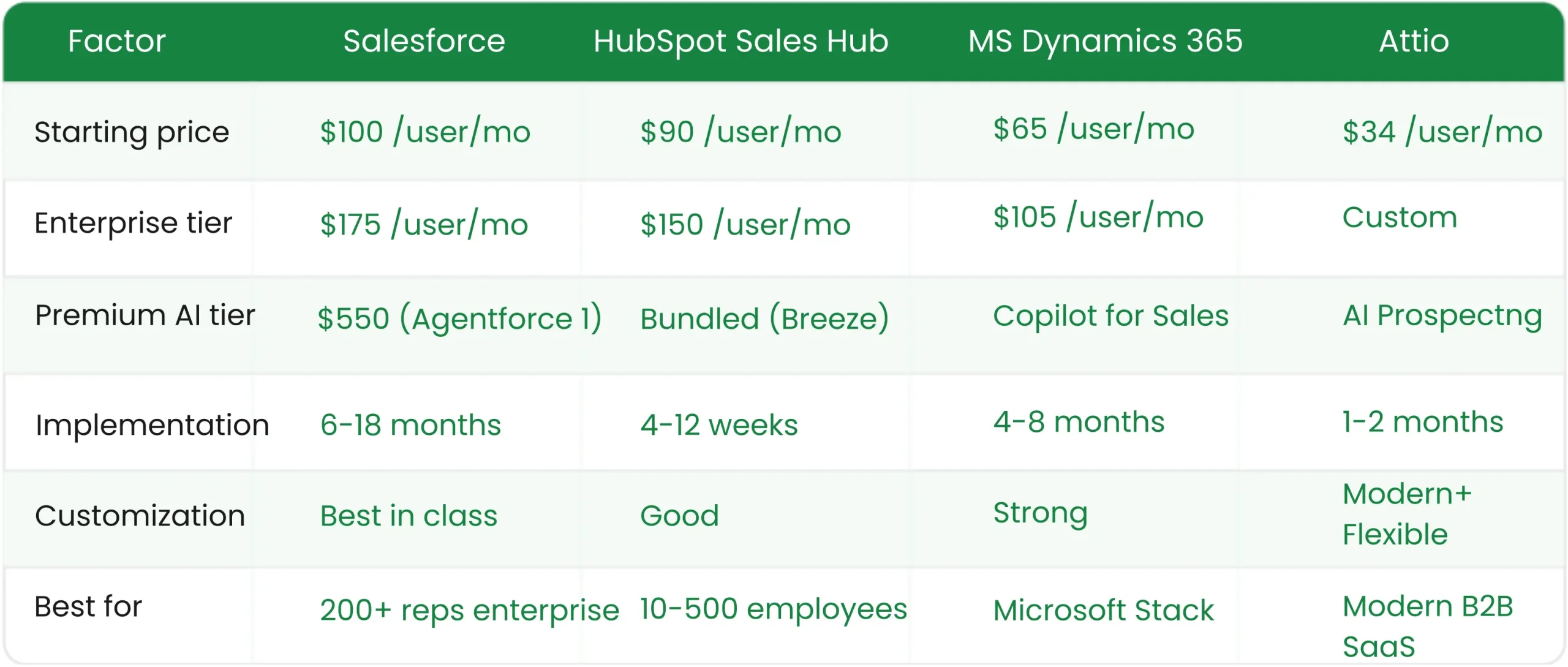
On Salesforce vs HubSpot: for this Salesforce Sales Cloud Review 2026, HubSpot wins on total cost of ownership, time-to-value, and usability for teams under 200 reps. Salesforce wins on customization depth, AppExchange ecosystem, and forecasting accuracy for teams above 200 reps with complex commercial models. The crossover is typically around 200 reps with a dedicated RevOps function.
Who Should Buy Salesforce Sales Cloud in 2026
Buy if: You have 200+ sales reps with complex commercial models. You’re in a regulated industry (finance, healthcare, public sector). You need multi-org or multi-currency capability. You can fund a dedicated Salesforce admin from day one. Forecasting accuracy is a CFO-level priority.
Skip if: Under 50 reps (HubSpot or Pipedrive will get you to 100 reps before becoming a constraint). You need fast time-to-value. You cannot fund implementation ($100K to $500K+ in Year 1). You’re already on Microsoft 365 (n a Salesforce vs Dynamics 365 comparison, Dynamics 365 at equivalent feature parity will be 30% cheaper).
Final Verdict: Salesforce Sales Cloud Review 2026
This Salesforce Sales Cloud review 2026 conclusion: Salesforce remains the most capable CRM on the market. The customization depth, AppExchange ecosystem, forecasting accuracy, and Agentforce AI capabilities create a platform that no competitor fully replicates at enterprise scale.
For 200+ rep enterprises with complex commercial models, regulated industries, or mature Salesforce expertise: Salesforce remains the right answer. The Agentforce 1 tier at $550/user/month is genuinely compelling for AI-first enterprise strategies.
For mid-market teams at 50 to 200 reps: the math gets harder every year. HubSpot, Microsoft Dynamics, and Attio have closed the gap on usability, time-to-value, AI capability, and cost. Run a rigorous Salesforce Sales Cloud review against these alternatives before committing.
For under-50-rep teams: Salesforce is almost always the wrong answer. The total cost of ownership crushes the value at that stage.Score: 8.4 / 10 | Buy if you have enterprise complexity that justifies the cost. Skip if you’re mid-market or want fast time-to-value.
FAQs:
Salesforce Sales Cloud review 2026: is it worth the cost?
For enterprises with 200+ reps and genuine complexity, yes. For everyone else, usually not. This Salesforce Sales Cloud review 2026 found that Salesforce pricing 2026 at Enterprise tier ($175/user/month) runs to $1M+ total cost for a 200-rep team in Year 1 when implementation, admin, and add-ons are fully counted.
What is Salesforce Agentforce 1 and is it worth $550/user?
Salesforce Agentforce 1 is the premium tier with full Einstein generative AI, autonomous agents, and unlimited platform customization. For enterprises with 200+ reps and AI-first strategies, the value can justify the cost. For mid-market teams, Enterprise tier at $175 plus selective AI add-ons typically delivers better ROI than the $550 all-in commitment.
Salesforce vs HubSpot in 2026: which is better?
On Salesforce vs HubSpot: for enterprise B2B with complex commercial models and 200+ reps, Salesforce wins on depth. For mid-market B2B at 10 to 500 employees, HubSpot delivers 80% of the value at 40% of the cost with significantly faster time-to-value. The tipping point is roughly 200 reps.
Is this a fair Salesforce Sales Cloud review 2026?
This Salesforce Sales Cloud review 2026 is based on pricing verified in April 2026, procurement data from real enterprise contracts, and technical evaluations across four Salesforce tiers. The score of 8.4 out of 10 reflects genuine enterprise capability alongside high TCO and implementation complexity that make it wrong for most teams below 200 reps.
How long does Salesforce implementation take?
Standard Enterprise tier implementation runs 6 to 12 months. Multi-cloud Unlimited deployments often take 12 to 18 months. Implementation cost typically equals 30 to 40% of Year-1 license spend. For a 200-rep Enterprise deployment, budget $120,000 to $170,000 in implementation alongside the $420,000 annual license.
What does Sales Cloud Einstein do in 2026?
Sales Cloud Einstein provides AI-driven forecasting, lead and opportunity scoring, activity capture, and pipeline analytics. At the Agentforce 1 tier, Sales Cloud Einstein expands into autonomous agents that take actions (update records, send emails, flag risks) rather than just providing recommendations. Full Einstein capability is only available at the Unlimited ($350) and Agentforce 1 ($550) tiers.
What about the August 2025 price increase?
Salesforce raised list prices roughly 6% across most editions in August 2025, the first increase in seven years. Renewing customers should expect 6 to 10% annual increases unless multi-year contracts with capped renewals are negotiated before the current term expires.
How does Salesforce compare to other enterprise CRM options?
In this enterprise CRM review, Salesforce leads on customization depth and AppExchange ecosystem. Microsoft Dynamics 365 is 30% cheaper at equivalent enterprise features for Microsoft 365 shops. HubSpot Enterprise delivers faster time-to-value for teams under 200 reps. Attio is the strongest modern challenger for B2B SaaS teams that prioritize UI and flexibility over enterprise legacy depth.