

Most sales compensation plan guides list the plan types and stop there: salary only, commission only, or base plus commission. That is the easy part. The hard part is the arithmetic that turns a revenue target into a rate a rep can trust, and a payout curve finance can afford at 60% attainment and at 140%.
This guide walks through that arithmetic. It sets out six design decisions in order, then shows three complete plans for SMB, mid-market, and enterprise account executives, with payouts calculated at four attainment levels. The figures are illustrations to show the method. Replace them with your own targets and market data.
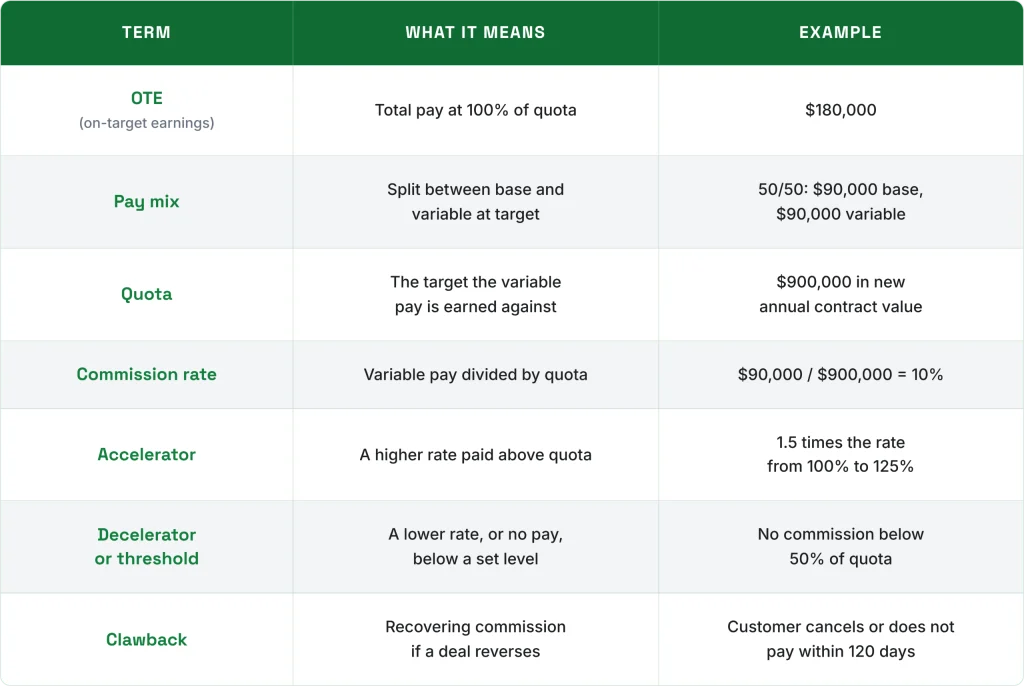
| Quick answer: A sales compensation plan defines how a salesperson is paid: a fixed base salary plus variable pay earned against a quota. To build one, set on-target earnings (OTE), choose the pay mix between base and variable, set the quota, divide variable pay by quota to get the commission rate, add accelerators for over-performance, and then write the rules for crediting, timing, and clawbacks into a signed plan document. |
The parts of a sales comp plan
How to build a sales compensation plan in six steps
Step 1: Write down what the plan must change.
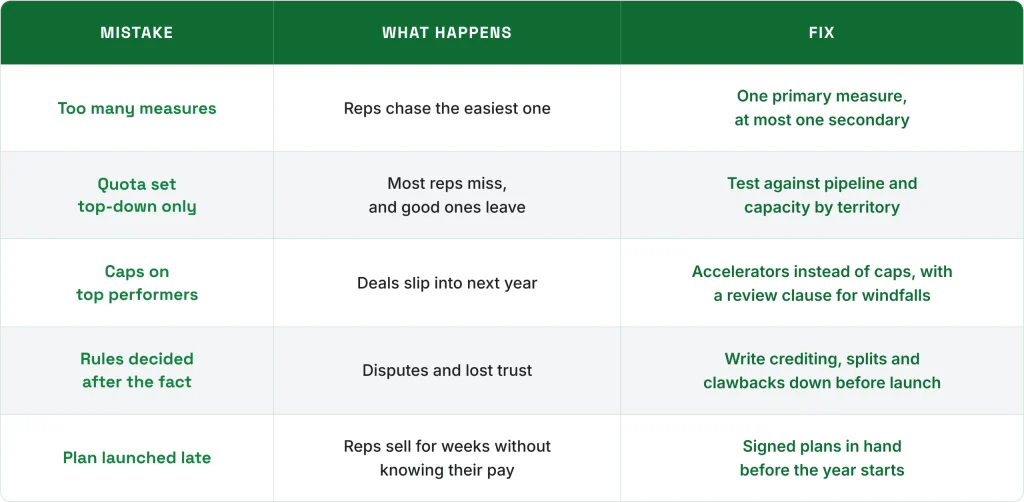
A plan pays for behavior. Before any numbers, list the one or two outcomes that matter most in 2027: new logos, expansion, multi-year terms, margin, or a new product line. Every extra measure dilutes the others. Most teams do best with one primary measure and, at most, one secondary measure worth 20% to 30% of variable pay. If AI SDR tools now book some of your meetings, decide now whether account executives are credited the same way for those meetings.
Step 2: Set OTE for each role.
OTE has to compete in the hiring market for that role and location. Use a current compensation survey or recruiter data, not last year’s offer letters. Set OTE by role and segment, because an SMB account executive and an enterprise account executive are different jobs.
Step 3: Choose the pay mix.
The more a rep directly controls the sale, the more of their pay can be variable. Long, complex enterprise deals and roles with heavy team involvement usually carry a lower variable share than fast transactional sales, because a single deal slipping a quarter should not wreck a rep’s income.
Step 4: Set the quota from the revenue plan, then sanity-check it.
Start from the company target, split it by segment and territory, and add a planning buffer so the business still hits its number if some reps miss. Then test the quota from the bottom up: pipeline coverage, average deal size, win rate, and ramp time for each territory. A quota that only works top-down will be missed, and missed quotas push good reps out.
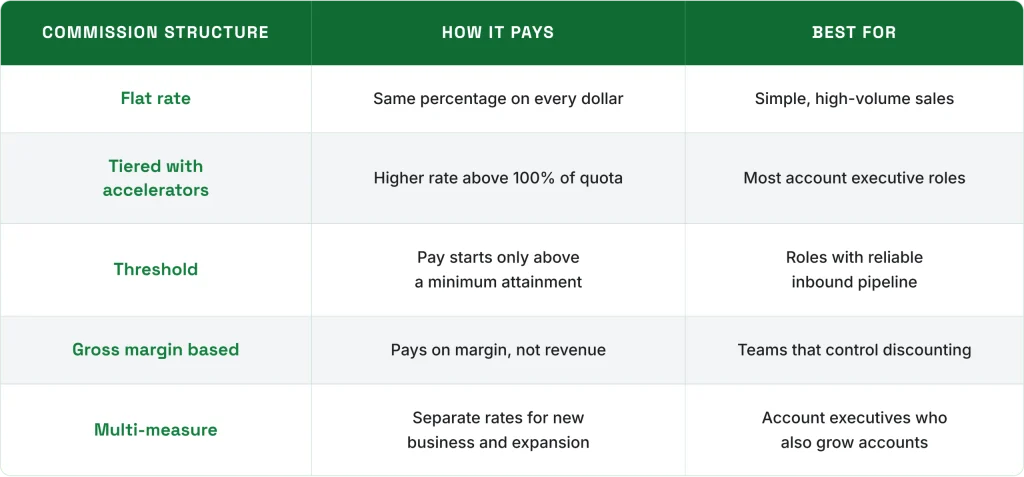
Step 5: Design the commission structure.
Divide variable pay by quota to get the base rate. Then decide the shape of the curve: where pay starts, how steeply it rises above 100%, and whether there is a cap. Uncapped plans with accelerators reward top performers; caps limit cost but can stall deals at the end of the year.
Step 6: Write the rules into a plan document.
The rules settle more disputes than the rates. Define when a deal is credited (signature, booking, or cash), how split deals are shared, how territory changes are handled mid-year, when commissions are paid, and when they can be clawed back. In California, Labor Code section 2751 requires commission agreements to be in writing, to set out how commissions are calculated and paid, and to be signed by the employee. Check the rules in every state and country where you employ reps.
Three worked sales compensation plan examples
The three plans below use the method above. All numbers are illustrations, not benchmarks.
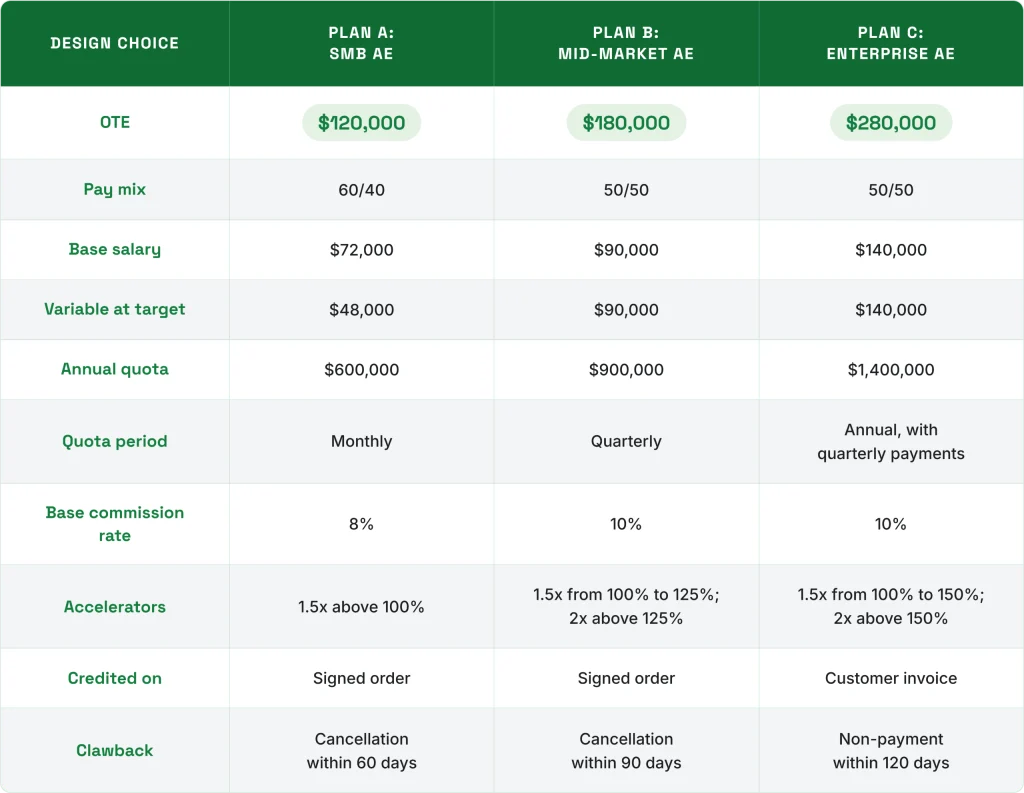
What each plan pays
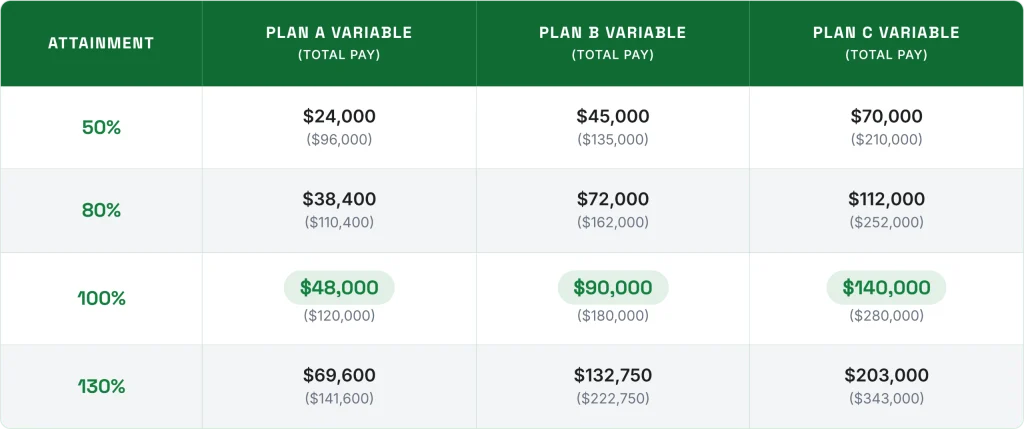
How the 130% figures are calculated
- Plan A: $48,000 at quota, plus $180,000 above quota × 8% × 1.5 = $21,600. Variable pay is $69,600.
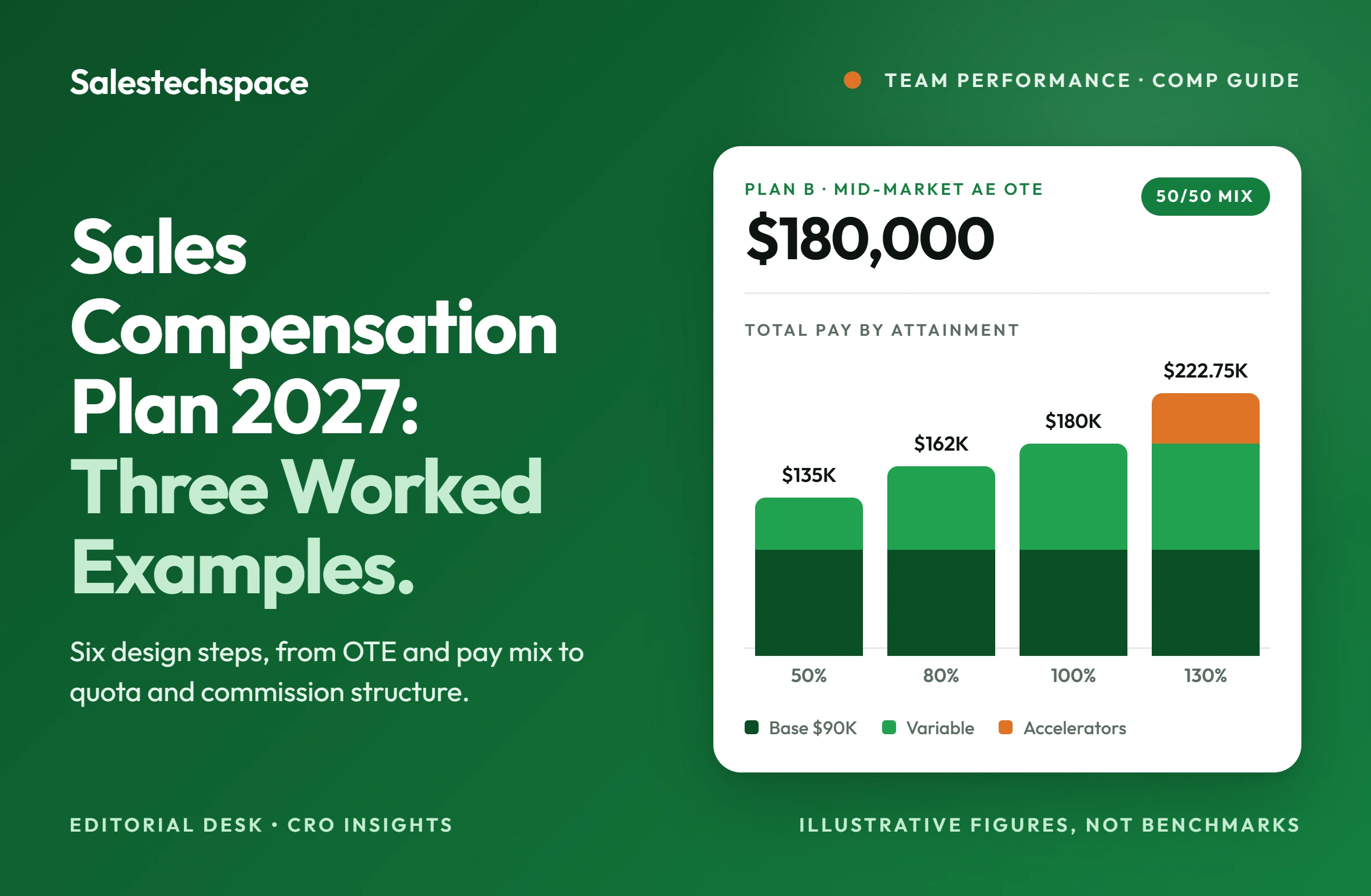
- Plan B: $90,000 at quota, plus $225,000 between 100% and 125% × 10% × 1.5 = $33,750, plus $45,000 above 125% × 10% × 2 = $9,000. Variable pay is $132,750.
- Plan C: $140,000 at quota, plus $420,000 above quota × 10% × 1.5 = $63,000. Variable pay is $203,000.
Run the same table for your plans before launch, then multiply by headcount and your expected attainment spread. That total is what finance needs to approve, not the cost at 100%.
Five checks before you launch
- Cost at the extremes: what does the plan cost if half the team hits 130% and the other half 60%?
- Rep math: can a rep work out their own payout from the plan document in five minutes?
- Timing: does the quota period match the sales cycle? Monthly quotas punish 90-day deals.
- Edge cases: Are splits, territory moves, leavers, and ramping new hires covered in writing?
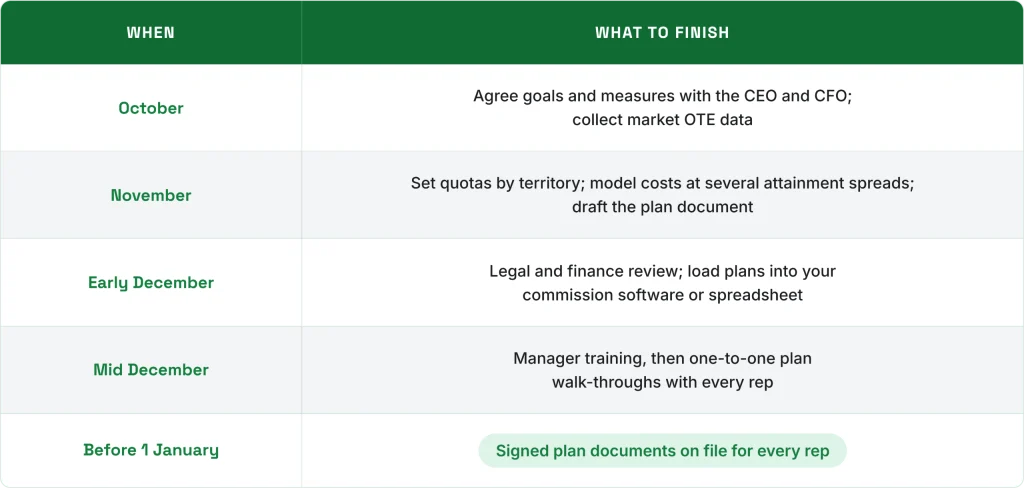
- Signatures: Has every rep signed and received a copy before the plan year starts?
Common sales compensation plan mistakes
A rollout timeline for a January 2027 plan year
For a deeper planning workbook, download The Ultimate Guide to Sales Compensation Planning. If your plans are getting too complex for spreadsheets, commission software can calculate payouts and show each rep how they were reached. For how the CRM data behind crediting should be set up, see our best B2B sales CRMs.
FAQs:
What is a sales compensation plan?
It is the written agreement that sets how a salesperson is paid, usually a base salary plus variable pay earned against a quota, with rules for crediting, timing, and clawbacks.
How do you calculate a commission rate?
Divide variable pay at target by quota. A rep with $90,000 variable pay and a $900,000 quota has a 10% base commission rate.
What is a good pay mix for account executives?
It depends on how much the rep controls the sale. Transactional roles often carry more variable pay than long, team-based enterprise sales.
Should a commission plan have a cap?
Most growth-focused teams avoid caps and use accelerators instead, with a review clause for unexpected windfall deals.
What is the difference between a sales compensation plan and a sales incentive plan?
The compensation plan covers all pay: base and variable. An incentive plan usually refers to the variable part or to short-term bonuses such as SPIFs.
Do commission plans need to be in writing?
In California, yes: Labor Code section 2751 requires written, signed commission agreements. Many other places require clear written terms, so check local law.