

For most of the last decade, Outreach vs Salesloft was a straight fight between two sequencing tools with similar features and different personalities. That framing is out of date. Clari and Salesloft completed their merger in December 2025, and Salesloft’s platform now lists Clari Forecast alongside Cadence, Conversation Intelligence, Deals, and Rhythm.
Outreach, meanwhile, has rebuilt itself around four Amplify packages, AI credits, and agents. So the 2026 question is no longer which sequencer is better. It is which revenue platform fits the way your team sells and what you will pay for it.
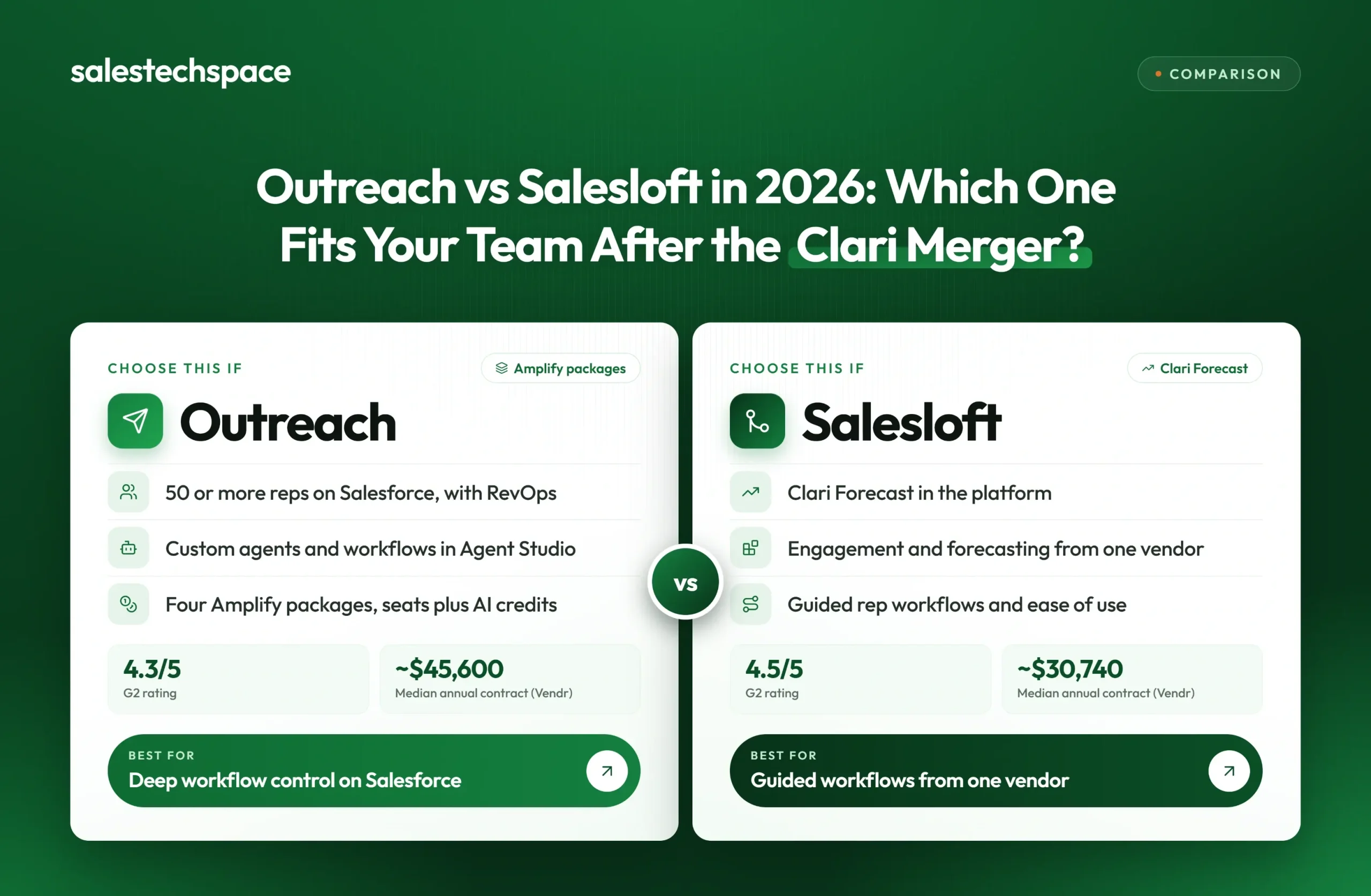
| Quick verdict: Choose Outreach if you run Salesforce, have RevOps capacity, and want deep workflow control with AI agents you can configure. Choose Salesloft if you want guided rep workflows and engagement, conversation intelligence, and Clari forecasting from one vendor. G2 users rate Salesloft higher for ease of use. Vendr’s contract data shows a lower median for Salesloft, but both quote by package and seat, so compare quotes for the same scope. |
What changed: the Clari and Salesloft merger
The merger, reported by destinationCRM, put Clari’s forecasting and pipeline inspection next to Salesloft’s engagement tools. On Salesloft’s platform page, forecasting, pipeline inspection, signals, and AI agents now sit in the same product family as cadences and call recording.
For buyers, that has two effects. First, teams that previously bought Outreach for engagement and Clari for forecasting now have a single-vendor alternative. Second, Outreach’s forecasting is concentrated in its top package, Amplify Pro, so a like-for-like comparison often means comparing Outreach Pro with a combined Salesloft and Clari Forecast bundle.
Outreach vs. Salesforce side by side
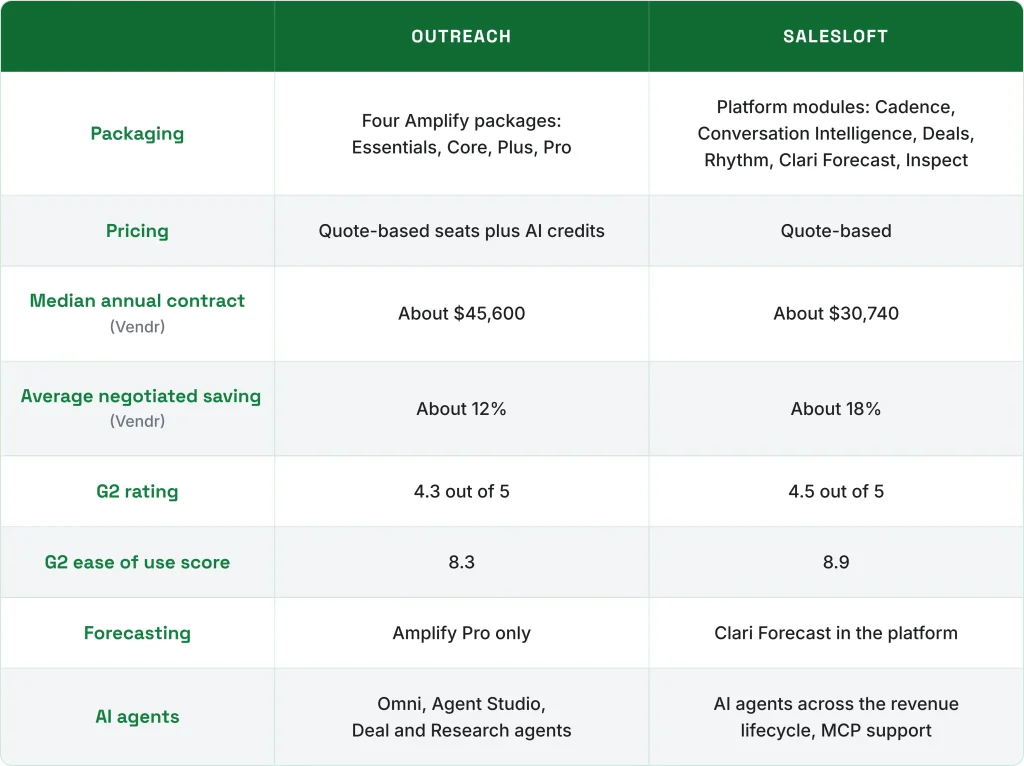
Sources: Outreach pricing, Salesloft’s platform page, Vendr purchase data for Outreach and Salesloft (updated February 2026), and the G2 comparison page, all checked on 23 October 2026.
Here is how the outreach vs. sales role decision usually splits by team.
Choose Outreach if
- Your team runs on Salesforce and has 50 or more reps, with a RevOps team to own the platform.
- You want to build custom agents and workflows. Outreach’s Agent Studio and API allowances are designed for that.
- You already buy forecasting elsewhere and want the deepest engagement platform alongside it.
- Your main need is coaching and call recording: Amplify Essentials is built around conversation intelligence.
Our Outreach pricing guide explains each Amplify package and how AI credits are metered.
Choose Salesloft if
- You want engagement, conversation intelligence, and forecasting from one vendor and one contract.
- Your reps value guided daily workflows and ease of use over deep configuration.
- You already use Clari for forecasting and want the engagement layer to match.
- You are a mid-market team without a large RevOps function to configure a platform.
When neither is the right answer
Both platforms reward teams that will use most of what they buy. If you have fewer than 15 reps and no admin, a lighter tool that combines data and sequences may cost a fraction as much. If your company runs on HubSpot, start with HubSpot’s own sales tools and add a separate platform only when you outgrow them. Outreach documents that its HubSpot email sync runs one way, so test the integration in a pilot. Our guide to AI SDR tools covers the lighter end of the market.
Outreach vs. Salesloft pricing: what to compare
Neither vendor publishes prices. Vendr’s purchase data, updated February 2026, puts the median Outreach contract at about $45,600 a year and the median Salesloft contract at about $30,740. Those medians mix very different deal sizes, so treat them as a sense of scale, not a quote.
To compare fairly, ask both vendors to price the same scope: the same seats, the same modules, and forecasting either included in both or excluded from both. With Outreach, get the AI credit allowance and the credit cost of your most-used actions in writing. With Salesloft, ask which modules are bundled and which are separate lines, especially Clari Forecast.
Switching from one to the other
Whichever way the Outreach vs. Salesloft decision goes, a switch between the two is mostly a process project.
- Export sequences or cadences, templates, and step logic, and rebuild the best five first rather than migrating everything.
- Map CRM sync settings field by field before go-live.
- Plan for rep downtime: switching engagement tools mid-quarter costs the pipeline.
- Keep call recordings and their retention settings in line with your consent policy.
- Time the switch to your renewal date, and give notice inside the required window.
FAQs:
Outreach vs. Salesloft: Which is better?
Neither is better for every team. Outreach suits Salesforce teams with RevOps support that want configurable workflows, while Salesloft suits teams that want guided workflows and Clari forecasting from one vendor.
Is Salesloft cheaper than Outreach?
Vendr’s data shows a lower median contract for Salesloft, about $30,740 against about $45,600, but both quote by scope, so compare quotes for the same seats and modules.
Did Salesloft merge with Clari?
Yes. Clari and Salesloft completed their merger in December 2025, and Salesloft’s platform now includes Clari Forecast.
Which has better reviews on G2?
On G2’s comparison page, checked 23 October 2026, Salesloft rates 4.5 out of 5 and Outreach 4.3, with Salesloft scoring higher on ease of use.
Does Outreach include forecasting?
Yes, but only in its top package, Amplify Pro, according to Outreach’s pricing page.
What are the best Outreach and Salesloft alternatives?
HubSpot Sales Hub for HubSpot-based teams, Apollo.io for small teams that want data and sequences together, and Gong for teams buying mainly conversation intelligence.