

Choosing the best B2B sales CRMs in 2026 is the decision that compounds. Get it right and reps stop fighting their tools. Get it wrong and the next 24 months go to data migration, retraining, and watching adoption collapse inside the first quarter. Sales reps spend only 28% of their day actually selling, according to Salesforce’s State of Sales report, and a bad CRM is one of the biggest reasons that number stays low.
This guide covers the 10 best B2B sales CRMs available in 2026: current pricing verified in April 2026, the AI features that actually shipped this year, and a direct answer on which platform fits your team’s size, motion, and existing stack.
Key Takeaways
- Salesforce Agentforce Sales is the enterprise standard. The Agentforce 1 plan with full AI agents runs $550/user/month. Worth it at 200+ reps with complex commercial models. Not before.
- HubSpot Sales Hub is the strongest all-in-one for growth-stage B2B. On the Salesforce vs. HubSpot question, HubSpot wins on total cost of ownership for teams under 200 reps.
- Pipedrive wins for sales-first teams with a defined pipeline. Fastest adoption, lowest setup cost, and genuinely capable AI sales assistant in 2026.
- Attio is the breakout challenger. An adaptive data model built for B2B SaaS revenue teams makes it the most credible alternative to legacy CRMs we have seen in years.
- The most expensive sales CRM platform is not the best fit. Define your sales motion and team size first. Pricing is the last filter, not the first.
How We Built This B2B CRM Comparison
This shortlist was built specifically for B2B revenue teams running multi-stakeholder sales with longer cycles. It is not a complete B2B CRM comparison of every platform on the market. Every platform here met all four criteria:
- B2B sales focus. Purpose-built for or widely proven in B2B environments: long sales cycles, account-based selling, and pipeline complexity beyond basic contact management.
- G2 rating of 4.3 or higher with a minimum of 1,000 verified reviews as of Q1 2026.
- Active product investment. Real AI and product releases in 2026, not a maintenance-only roadmap.
- Proven adoption at scale. Used by at least 500 B2B revenue teams with verifiable references across multiple industries.
All pricing was sourced directly from official vendor pages and verified in April 2026. Figures were cross-checked against procurement benchmarks from Vendr and SaaS deal data from Q1 2026.
The 10 Best B2B Sales CRMs in 2026
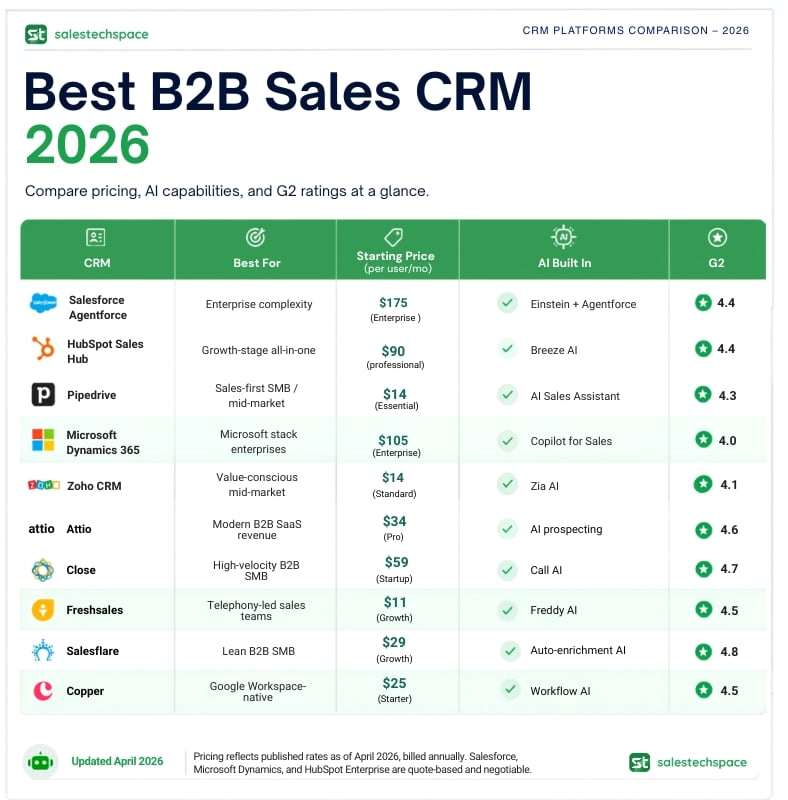
1. Salesforce Agentforce Sales—Best for Enterprise Complexity
Pricing: $175 (Enterprise), $350 (Unlimited), or $550 (Agentforce 1) per user/month.
Salesforce is the default enterprise CRM 2026 choice for a reason. The platform handles anything from a small pipeline to millions of leads without performance degradation. Einstein AI has matured into a genuinely agentic system under the Agentforce umbrella: it researches prospects autonomously using public filings, social activity, and news, then prepares reps with personalized meeting briefs before they pick up the phone.
Data Cloud integration unifies internal and external data sources in real time, without the ETL pipelines that used to require dedicated engineering work. The Slack-first approach means deal updates, approvals, and pipeline reviews happen inside the workspace where your team already operates.
Strengths
- Handles the most complex commercial models in the category: multi-product, multi-geo, compliance-heavy
- Agentforce AI agents research accounts and generate outreach independently
- Largest integration ecosystem: 5,000+ apps on AppExchange
- Tableau integration delivers BI-grade reporting that no other CRM matches natively
- Global network of certified admins and implementation partners
Weaknesses
- Requires dedicated admins or consultants to implement and operate effectively
- Total cost of ownership regularly runs 1.7 to 2x the license fee in Year 1
- The interface is feature-dense and can overwhelm teams that do not need that complexity
- Implementation projects regularly run 3 to 6 months before reps are fully productive
Best for: Companies with 200+ sales users, complex commercial models, or compliance-heavy industries such as financial services, healthcare, and global enterprise.
Skip it if: You have fewer than 50 reps. The cost and complexity will slow you down, not speed you up.
2. HubSpot Sales Hub – Best All-in-One for Growth-Stage B2B
Pricing: Free / $15 (Starter) / $90 (Professional) / $150 (Enterprise) per user/month
The Salesforce vs. HubSpot question comes down to one trade-off: power versus speed. HubSpot wins for any team that needs to be operational in days rather than months. As the leading best B2B sales CRM for growth-stage teams, it combines CRM, marketing automation, sales sequencing, and customer service in one platform, eliminating the integration tax that comes with piecing together Salesforce, Marketo, and Zendesk separately.
Breeze AI handles predictive lead scoring, automated follow-up suggestions, and conversation analysis across email and calls. The Professional tier at $90/user/month delivers everything most 50 to 200-rep teams need without triggering an enterprise procurement process.
Strengths
- Fastest time to value in the mid-market: operational inside a week, not months
- Single platform for CRM, marketing, sales, and service on shared data
- Breeze AI across lead scoring, email assistance, and deal insights
- The Free tier is genuinely useful for smaller teams evaluating before committing
- Clean native integrations with modern B2B tools: Apollo, LinkedIn, Slack, and Stripe
Weaknesses
- Less configurable than Salesforce for genuinely complex enterprise commercial models
- Pricing escalates meaningfully with contact volume growth
- Advanced analytics and forecasting rival enterprise-grade BI tools
- Multi-layered sales processes with complex approval chains work better in Salesforce
Best for: B2B SaaS, agencies, and service companies between 10 and 500 employees that want CRM, marketing, and service in one consolidated stack.
Skip it if you have more than 200 reps with complex territory hierarchies or compliance requirements that demand Salesforce-level customization.
3. Pipedrive—Best Sales-First CRM for SMB and Mid-Market
Pricing: $14 (Essential) / $29 (Advanced) / $49 (Professional) / $99 (Power) per user/month
Pipedrive is the sales CRM platform built for teams that know their process and want the CRM to stay out of the way. Activity-based selling ties every deal to a required next action so nothing falls through the cracks. The visual pipeline is the cleanest drag-and-drop interface in this comparison: reps see exactly where every deal stands without navigating menus or running reports.
The 2026 AI Sales Assistant is a meaningful upgrade. It flags at-risk deals, suggests next actions based on historical deal patterns, and generates personalized email drafts from CRM context. For teams at the Essential or Advanced tier, it is the fastest path to an AI-assisted selling workflow without enterprise overhead.
Strengths
- Fastest onboarding: most teams are active within 2 to 3 days
- The visual pipeline is the clearest deal-stage view in this comparison
- AI Sales Assistant delivers real-deal coaching without complex setup
- Transparent, predictable per-user pricing with no contact volume penalties
- Strong workflow automation for follow-ups, reminders, and deal progression
Weaknesses
- Marketing automation is minimal; pairs better with a dedicated tool like HubSpot
- Reporting is functional but not BI-grade for large teams
- Advanced customization and complex approval flows are limited versus Salesforce
- Some power features, including AI and automation, only unlock on higher tiers
Best for: B2B sales teams of 5 to 100 reps with a defined, repeatable sales process that want execution speed over CRM complexity.
Skip it if you need deep marketing automation, advanced analytics, or enterprise-level customization.
4. Microsoft Dynamics 365 Sales – Best for Microsoft-Stack Enterprises
Pricing: $65 (Sales Professional) / $105 (Sales Enterprise) per user/month
Microsoft Dynamics 365 Sales is the natural enterprise CRM 2026 choice for organizations already standardized on Microsoft 365. It operates inside Outlook, Teams, and Excel rather than asking reps to switch context to a separate tool, which is a meaningful adoption advantage in organizations where Microsoft is the default workflow layer.
Copilot for Sales, Microsoft’s AI layer, handles meeting preparation, follow-up drafting, and CRM record updates automatically after calls and emails. For enterprises already paying for Microsoft 365 Copilot licenses, this is an incremental capability rather than a net-new cost.
Strengths
- Works inside Outlook, Teams, and Excel: no context switching for Microsoft-first teams
- Copilot for Sales handles meeting prep, follow-ups, and record updates automatically
- Scales to global enterprise complexity with deep customization options
- Existing Microsoft 365 licenses reduce incremental CRM cost materially
Weaknesses
- Requires technical expertise or an implementation partner to configure properly
- The interface is less modern than HubSpot, Pipedrive, or Attio
- Feels unnecessarily complex for teams under 100 reps
- Implementation typically runs 3 to 6 months before reps are fully productive
Best for: Enterprises of 500+ employees already standardized on Microsoft 365 where IT consolidation and compliance take priority over CRM-first usability.
Skip it if you are not already in the Microsoft ecosystem or your team prioritizes a recruiter-first UI over platform integration.
5. Zoho CRM – Best Value Mid-Market CRM
Pricing: Free / $14 (Standard) / $35 (Professional) / $50 (Enterprise) / $65 (Ultimate) per user/month
Zoho CRM offers the best B2B CRM pricing in this comparison for teams that need enterprise-level capability without enterprise-level budget. At $50/user/month for the Enterprise tier, it delivers features that cost two to three times more elsewhere: advanced workflow automation, AI-powered lead scoring via Zia, and a genuinely comprehensive analytics suite.
Zia, Zoho’s AI assistant, provides anomaly detection on your pipeline, lead scoring based on behavioral signals, email sentiment analysis, and sales predictions. The broader Zoho ecosystem covering finance, HR, and marketing means teams can consolidate their entire business software stack under one vendor if they want to.
Strengths
- Enterprise features at SMB pricing: the most competitive B2B CRM pricing in this comparison
- Zia AI covers lead scoring, anomaly detection, predictions, and email assistance
- Broad Zoho ecosystem for finance, HR, marketing, and support
- Deep customization options across objects, workflows, and reporting
Weaknesses
- The Interface feels less polished than HubSpot, Pipedrive, or Attio
- Feature volume can overwhelm teams that do not need broad platform depth
- Some users report performance lag in large deployments
- Third-party integration quality varies; native Zoho tools work better than external ones
Best for: Mid-market B2B teams of 50 to 500 employees that want the best cost-to-feature ratio and are comfortable trading UI polish for platform depth.
Skip it if your team prioritizes a clean, modern interface or you need best-in-class integration with non-Zoho tools.
6. Attio – Best Modern CRM for B2B SaaS Revenue Teams
Pricing: Free / $34 (Pro) / $79 (Plus) per user/month / Enterprise: contract-based.
Attio is the most interesting and best B2B sales CRM challenger in this list. Its adaptive data model lets revenue teams define their own objects, relationships, and pipelines rather than fitting into predefined templates. For B2B SaaS teams where the standard deal structure does not match the product-led, community-led, or partner-led motion, that flexibility alone justifies the evaluation.
The AI prospecting layer identifies qualified accounts from your ICP, estimates deal potential, and surfaces decision-makers automatically. The interface is closer to Notion or Linear than any traditional CRM, which drives faster adoption from modern teams that have grown impatient with legacy UX.
Strengths
- Adaptive data model: configure any object and relationship without developer support
- Highest G2 rating in this comparison at 4.6 out of 5
- A modern interface drives strong rep adoption from day one
- AI prospecting surfaces ICP-fit accounts and decision-makers automatically
- Built for product-led, community-led, and partner-led B2B GTM motions
Weaknesses
- Requires upfront configuration to match your workflow; not plug-and-play
- Fewer third-party integrations than Salesforce or HubSpot
- Lacks some deep enterprise compliance and governance features
- Smaller implementation partner network than legacy CRM vendors
Best for: B2B SaaS, fintech, and modern services companies under 200 employees building a clean, flexible revenue stack without legacy CRM baggage.
Skip it if you need a large pre-built integration ecosystem or operate in a heavily regulated industry that requires enterprise-grade compliance controls.
7. Close – Best for High-Velocity B2B SMB Sales
Pricing: $59 (Startup) / $109 (Professional) / $149 (Enterprise) per user/month
Close is the AI sales CRM built for inside sales teams that live and die by outbound volume. Calling, SMS, email, and CRM record management all run in a single workspace so reps never need to switch context or manually log activity between tools. The built-in power dialer is smoother than most third-party integrations and requires no separate license to operate.
Call AI, Close’s 2026 AI feature, transcribes every call, summarizes the conversation, extracts action items, and updates CRM fields automatically. For teams where post-call admin eats 30 to 40 minutes per rep per day, that is a meaningful operational gain.
Strengths
- Built-in dialer, SMS, and email in one workspace: no third-party tools required
- Call AI handles transcription, summaries, and CRM updates automatically
- Power dialer purpose-built for high-volume SDR and inside sales workflows
- G2 rating of 4.7: second highest in this comparison
Weaknesses
- Not designed for marketing automation or complex multi-channel campaigns
- Fewer integrations than HubSpot or Salesforce
- Analytics are solid for sales activity but not enterprise-grade for pipeline reporting
- Less suited for long, complex enterprise sales cycles
Best for: B2B SaaS and services companies running high-volume outbound with 5 to 50 reps where dialing and calling efficiency is the primary metric.
Skip it if your primary motion is inbound or account-based, or you need deep marketing automation capability alongside your CRM.
8. Freshsales – Best for Telephony-Led B2B Sales Teams
Pricing: Free / $11 (Growth) / $47 (Pro) / $71 (Enterprise) per user/month
Freshsales is a sales CRM platform that combines calling, email, chat, and contact management in one workspace without requiring separate communication tool licenses. For B2B SMBs where the telephone is still the primary channel and IT budgets are limited, having a CRM and dialer on a single bill is a genuine operational advantage.
Freddy AI, Freshworks’ intelligence layer, scores leads based on behavioral signals, highlights which deals are most likely to close this week, and suggests next best actions for reps who are unsure what to prioritize. Clean onboarding and an intuitive interface mean most teams are running inside a week.
Strengths
- Phone, email, and chat built into the CRM: single bill, and single login
- Freddy AI handles lead scoring, deal insights, and next-action recommendations
- Clean interface with fast onboarding for teams with limited IT resources
- Growth tier at $11/user/month is the most affordable full-featured option in this list
Weaknesses
- Reporting depth is weaker than enterprise CRMs
- Fewer third-party integrations than Salesforce or HubSpot
- Full marketing capability requires additional Freshworks products, not included in base plans
- Scales less cleanly into complex enterprise environments with large org hierarchies
Best for: B2B SMBs under 100 employees that rely heavily on phone outreach and want CRM plus telephony in a single affordable platform.
Skip it if your primary channel is email or content and you need advanced marketing automation alongside your CRM.
9. Salesflare – Best Lean CRM for B2B SMB
Pricing: $29 (Growth) / $49 (Pro) / $99 (Enterprise) per user/month
Salesflare is built around one insight: reps do not update CRMs because manual data entry is painful. Its solution is to eliminate manual entry entirely. Salesflare automatically pulls contact information, company data, and interaction history from Gmail, Outlook, and LinkedIn, logging every email, meeting, and call without a rep touching the keyboard.
For lean B2B SMB teams where data hygiene is the number one problem and headcount is too small to dedicate anyone to CRM administration, that automatic enrichment model is a genuine differentiator. The highest G2 rating in this entire comparison at 4.8 out of 5 reflects strong user satisfaction from small teams that benefit from it most.
Strengths
- Auto-enrichment from Gmail, Outlook, and LinkedIn: near-zero manual data entry
- Highest G2 rating in this comparison: 4.8 out of 5
- Simple, focused interface built for selling rather than CRM administration
- Visual pipeline with automated reminders and follow-up nudges
Weaknesses
- Not suited for complex or heavily customized sales processes
- Analytics and reporting are minimal compared to enterprise CRMs
- Fewer integrations than larger platforms
- Can feel restrictive at scale or with larger, structured org hierarchies
Best for: Lean B2B SMBs of 5 to 25 reps where manual data entry is the primary CRM adoption problem.
Skip it if you need advanced analytics, complex workflow automation, or a platform that can scale past 50 reps without configuration constraints.
10. Copper – Best for Google Workspace-Native B2B Teams
Pricing: $25 (Starter) / $59 (Basic) / $99 (Professional) per user/month
Copper lives inside Google Workspace. Gmail, Google Calendar, and Google Drive all sync automatically, pulling deals, contacts, and activity logs directly into the workflow your team already uses. For B2B services and agency teams that run entirely on Google tools, the value is immediate: there is no separate CRM interface to learn or toggle between.
Auto data capture logs every email, meeting, and contact without manual input. The Starter tier at $25/user/month makes it the most affordable full-CRM option in this list for Google-first teams. It is a focused tool with a clear use case, and it does that use case well.
Strengths
- Native Google Workspace integration: works inside Gmail, Calendar, and Drive
- Auto-captures emails, meetings, and contacts without manual entry
- Fastest setup for Google-first teams: most teams are live in under a day
- Affordable entry pricing at $25/user/month
Weaknesses
- No Microsoft 365 or Outlook support: Google-only
- Weaker analytics and BI capabilities than enterprise CRMs
- Costs rise quickly at higher tiers and with larger teams
- Not suited for complex enterprise workflows or multi-department coordination
Best for: B2B services, consultancies, and agency teams of 5 to 50 reps running entirely on Google Workspace.
Skip it if your team uses Microsoft 365 or needs CRM capability beyond sales contact and deal management.
How to Choose the Right B2B Sales CRM in 2026
Most B2B CRM comparison exercises fail because they start with features rather than motion. Work through this four-step framework first.
Step 1 – Define Your Sales Motion
- High-velocity inbound (web to demo to close under 30 days): HubSpot, Close, Freshsales
- Outbound SDR-led (multi-touch, 30 to 90-day cycles): Pipedrive, Close, Attio
- Field or enterprise (multi-stakeholder, 90+ day cycles): Salesforce, Microsoft Dynamics, HubSpot Enterprise
Account-based or strategic (named accounts, complex commercial): Salesforce, Microsoft Dynamics
Step 2 – Match to Team Size and Ops Maturity
| Team Size | Ops Maturity | Recommended CRMs |
| 1-10 reps | Founder-led, no ops | Pipedrive, Attio, Salesflare, HubSpot Free |
| 10-50 reps | Sales ops emerging | HubSpot, Pipedrive, Close, Zoho CRM |
| 50-200 reps | Dedicated RevOps | HubSpot Enterprise, Salesforce Pro, Attio |
| 200+ reps | Mature RevOps | Salesforce Enterprise/Unlimited, Microsoft Dynamics 365 |
Step 3 – Pressure-Test Integrations and AI
Before signing with any AI sales CRM, verify two things. First, list every system the CRM must connect to: marketing automation, sales engagement, data enrichment, forecasting, communication, and billing. If your shortlisted CRM lacks a stable native integration with each of these, the implementation project becomes significantly more complex than the vendor’s sales deck suggests.
Second, pressure-test the AI claims. Every platform has AI in 2026. Ask for a live demo of the specific AI feature that matters for your use case, not a recorded video. See it work on real data, not sample data. Ask what happens when the AI is wrong and how reps correct it.
Step 4 – Budget Beyond Licenses
Most teams underestimate B2B CRM pricing because they budget licenses and stop there. A realistic Year 1 total cost of ownership looks like this:
- Light setup (Pipedrive, Attio, Close, Salesflare): 1.1 to 1.3 times the license cost
- Medium setup (HubSpot, Zoho, Freshsales, Copper): 1.3 to 1.7 times the license cost
- Heavy setup (Salesforce, Microsoft Dynamics): 1.5 to 2.0 times the license cost
For Salesforce at the enterprise tier, implementation cost alone often equals the Year 1 license fee. That number is real and rarely surfaces during the initial procurement conversation.
Common B2B CRM Mistakes to Avoid
Five mistakes show up repeatedly in best B2B sales CRM rollouts across every company size:
- Buying for the future, not the present. A 20-rep team purchasing Salesforce Enterprise because ‘we will grow into it’ almost always regrets the cost and complexity before that growth arrives.
- Skipping data hygiene before migration. A new CRM does not fix dirty data. It just moves the problem to a more expensive container.
- Letting AI features drive the decision. Every vendor has AI in 2026. The data model, automation reliability, and integration stability matter far more over a 3-year horizon.
- Underbudgeting implementation. Plan for 30 to 40% of the license cost in implementation and training spend in Year 1, minimum.
No defined adoption metric. Pick one number (‘85% of deals updated in the last 7 days’) and tie team behavior to it from week one. Without a metric, adoption drifts.
Final Verdict
The 10 platforms in this guide cover every meaningful B2B sales motion in 2026. There is no single best B2B sales CRM. There is only the right fit for your team’s stage, sales motion, and existing technology stack.
| Under 25 reps, growth-stage: HubSpot or Pipedrive. Both scale past 100 reps before becoming a constraint. 25 to 200 reps, modern B2B SaaS: Take Attio seriously. It is the most credible challenger to legacy CRMs in 2026. 200+ reps, enterprise complexity: Salesforce Agentforce Sales remains the default. Pressure-test Microsoft Dynamics 365 if you are already on Microsoft 365. High-velocity outbound at any size: Close is purpose-built for this, and nothing in this comparison matches it for that specific motion. |
Decide, implement properly, and commit for at least 24 months. Every CRM on this list works when paired with disciplined data hygiene, clear adoption metrics, and consistent rep usage. None of them work when those things are absent. Shortlist your top two. Schedule demos the same week. Bring three reps to both. The people using the tool every day should have the loudest voice in the final decision.
FAQs:
What is the best B2B sales CRM in 2026?
Salesforce wins for enterprise complexity. HubSpot wins for growth-stage all-in-one needs under 200 reps. Pipedrive wins for sales-first SMBs with a defined pipeline. Attio is the strongest modern challenger for B2B SaaS revenue teams. There is no single right answer without knowing your sales motion, team size, and stack.
How much does a B2B sales CRM cost in 2026?
Pricing ranges from free tiers at HubSpot, Zoho, and Freshsales to $550 per user per month for Salesforce Agentforce 1. Most growth-stage B2B teams spend $50 to $150 per user per month. Always add 30 to 40% to the license cost for implementation and onboarding in Year 1.
Salesforce vs. HubSpot: Which is better for B2B in 2026?
Salesforce vs. HubSpot is the most common B2B CRM decision in the market. For teams under 200 reps, HubSpot wins on total cost of ownership, time to value, and usability. For teams over 200 reps with complex commercial models, Salesforce’s customization depth and integration ecosystem justify the premium. The crossover point is typically 150 to 200 reps with a dedicated RevOps function.
Which B2B sales CRM has the best AI in 2026?
Salesforce Agentforce offers the most capable autonomous AI agents for enterprise use. HubSpot Breeze and Microsoft Copilot for Sales are the strongest mid-market AI layers. Pipedrive’s AI Sales Assistant is the most useful for SMB deal coaching. Attio’s AI prospecting is the standout feature among modern challengers.
How long does CRM implementation take?
Salesflare and Copper can go live in under a day for small teams. Pipedrive and Close typically take 2 to 5 days. HubSpot and Zoho run 2 to 4 weeks. Salesforce and Microsoft Dynamics regularly run 3 to 6 months and sometimes longer with complex customization requirements.
Can I switch CRMs later if I outgrow my current one?
Yes, but for any team with more than 25 reps and active sequences, it is a 3 to 6-month project. Data export, field mapping, integration rebuilds, sequence migration, and rep retraining all compound. Switching costs are real. Choose carefully now and commit for at least 24 months before re-evaluating.
Which B2B CRM has the best integrations?
Salesforce has the largest ecosystem with 5,000+ apps on AppExchange. HubSpot has the cleanest native integrations with modern B2B tools, including Apollo, LinkedIn Sales Navigator, Slack, and Stripe. Microsoft Dynamics is unmatched inside Microsoft 365. For modern tech stacks, HubSpot’s integration quality typically beats Salesforce’s quantity for teams under 200 reps.