

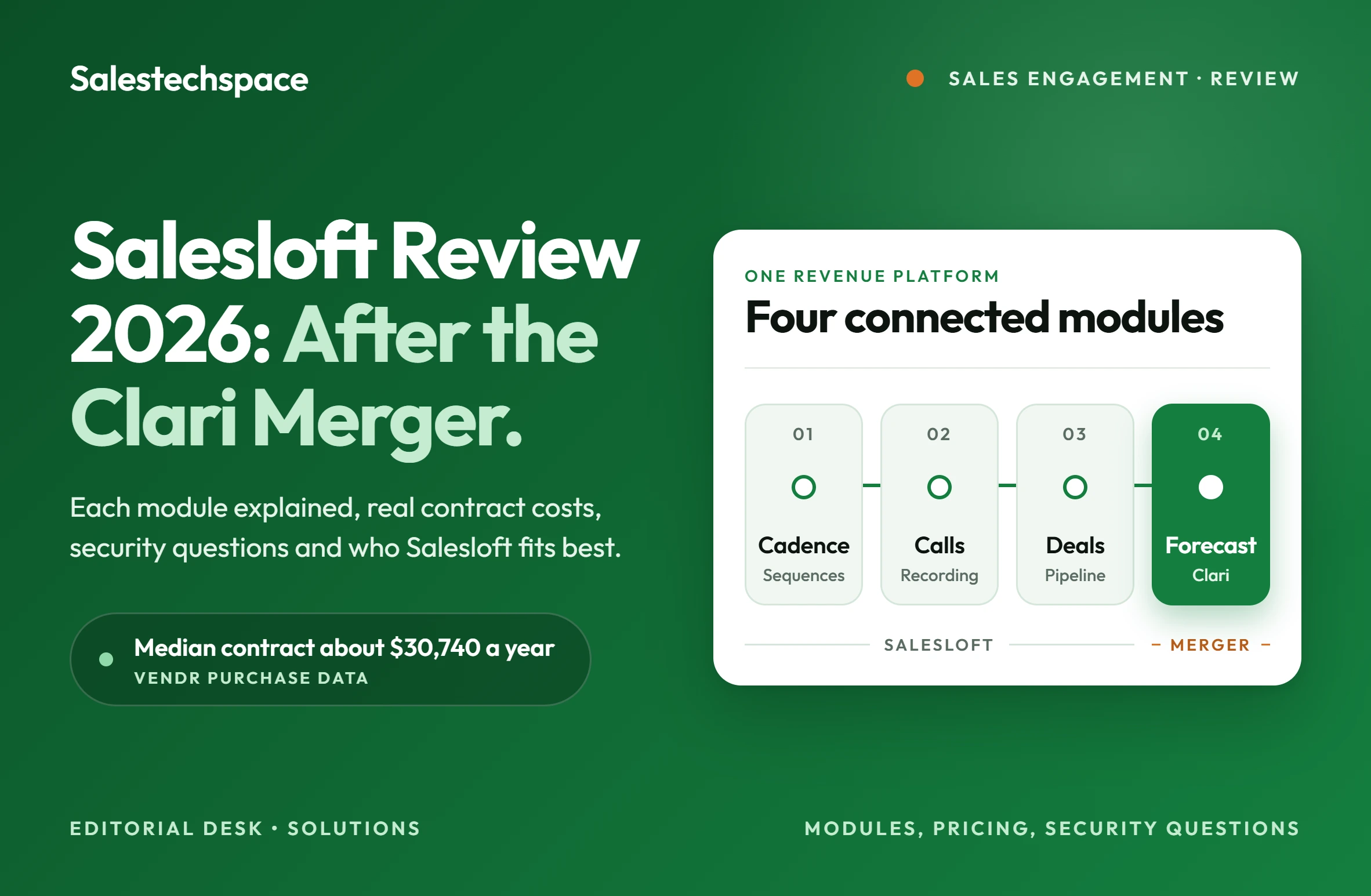
Salesloft spent most of its history as one of the two leading sales engagement platforms, competing feature for feature with Outreach. Two deals changed that. It bought Drift, the conversational marketing company, in February 2024, and it completed its merger with Clari, the forecasting and revenue intelligence vendor, in December 2025.
The result is a broader product than many buyers remember. This Salesloft review explains what each part of the platform does today, what customers pay on real contracts, the security questions worth asking after the 2025 Drift incident, and which sales teams get the most from it.
| Quick verdict: Salesloft suits mid-market and enterprise sales teams that want cadences, call recording, deal management, and forecasting from one vendor, with guided daily workflows for reps. G2 users rate it 4.5 out of 5 and score it highly for ease of use. Pricing is quote-based; Vendr’s purchase data puts the median contract at about $30,740 a year. Teams that need deep custom workflows, or small teams without an admin, should compare alternatives before signing. |
What Salesloft is in 2026
Salesloft’s platform page now groups its products into one revenue platform. The main parts:
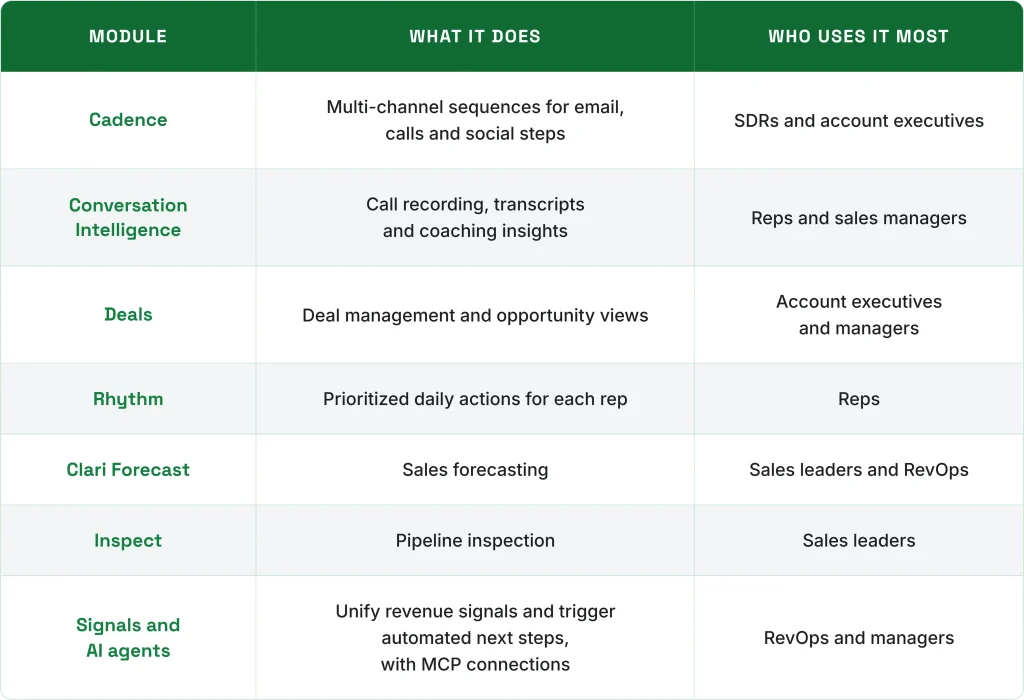
The practical meaning: a sales team can now buy engagement and forecasting from the same vendor. Before the merger, many companies ran Salesloft or Outreach for engagement and bought Clari separately for forecasting.
Salesloft review by module
Cadence: the core of the product
Cadence is where reps spend their day. It builds multi-step sequences that mix emails, calls, LinkedIn steps, and tasks; syncs activity to the CRM; and lets managers share proven cadences across the team. Salesloft’s long-standing strength here is ease of use: on G2’s comparison page, users score Salesloft 8.9 for ease of use against 8.3 for Outreach (checked 23 October 2026).
What to check: how sending limits and mailbox health are managed across many reps, and how the CRM sync handles custom objects and fields in your Salesforce or HubSpot setup.
Conversation Intelligence: calls and coaching
Calls are recorded and transcribed, and managers can review conversations, find coaching moments, and track talk patterns. For teams that previously bought a separate conversation intelligence tool, this can remove one contract. Compare it with dedicated tools on language support, recording consent controls, and how insights reach the CRM.
Rhythm: what to do next
Rhythm turns signals from email, calls, deals, and the CRM into a prioritized list of actions for each rep. Teams with many accounts per rep benefit most, because the hard part of their day is choosing who to contact next. Ask how Rhythm ranks actions and whether managers can adjust the logic.
Deals, Inspect, and Clari Forecast
Deals gives reps and managers a working view of open opportunities, Inspect supports pipeline reviews, and Clari Forecast brings Clari’s forecasting into the platform. For sales leaders, the value is one place to move from activity to pipeline to forecast. The integration is recent, so ask which parts run as one product today and which still use separate logins or data models. Salesloft’s own login links still point some products to Clari domains.
Signals, AI agents, and MCP
Salesloft describes a live signals layer and AI agents that act across the revenue lifecycle, with examples such as forecast summaries, deal risk plays, and meeting preparation. It also supports MCP connections to share revenue context with other AI tools. As with any agent features, decide in advance which actions agents may take without a person and which CRM fields they may change. Our guide to AI SDR tools explains how to judge how much an agent really does on its own.
Salesloft pricing
Salesloft does not publish prices. Quotes depend on seats, modules, and contract length. Vendr’s purchase data, updated February 2026, gives a sense of scale:
- Median annual contract: about $30,740
- Recorded contracts: from about $5,152 to $146,494 a year
- Average negotiated saving: about 18%
Source: Vendr’s Salesloft page. Third-party sites quote plan names and per-seat prices that Salesloft itself does not publish, so treat those as unconfirmed. The main things that move a Salesloft quote are the number of seats, which modules you add on top of Cadence, contract length, and whether forecasting users are licensed separately from reps. Multi-year terms usually lower the yearly price but reduce flexibility if your team shrinks, so ask for the right to reduce seats at renewal and a cap on price increases. To compare fairly, ask for a line-item quote showing each module, especially Conversation Intelligence and Clari Forecast, and price the same scope with any alternative.
Security: questions to ask after the 2025 Drift incident
In August 2025, attackers stole OAuth tokens connected to Salesloft’s Drift chat integration and used them to access data in customers’ Salesforce instances between 8 and 18 August 2025, according to BleepingComputer, citing Salesloft and Google’s Threat Intelligence Group. Salesloft revoked the affected tokens in coordination with Salesforce, and Salesforce disabled the integrations while the investigation ran.
The incident is a reminder that every connected sales tool holds access to your CRM. Whichever engagement platform you choose, ask the vendor:
- Which OAuth scopes does each integration request, and can we limit them?
- How are integration tokens stored, rotated, and revoked?
- What changed in your security program after August 2025, and what independent assessments can you share?
- How quickly will you notify us of an incident affecting our data?
- Can we see logs of what the integration accessed in our CRM?
These questions apply equally to Outreach, Gong, Apollo, and any other tool connected to Salesforce or HubSpot.
Salesloft review summary: strengths and limits
Pulling the modules, pricing, and security points together, this Salesforce review comes down to a short list.
- Strength: one vendor for cadences, call recording, deal management, and forecasting, which removes at least one contract for many teams.
- Strength: high ease-of-use scores from G2 users, which matters for rep adoption.
- Strength: Rhythm gives reps a prioritized daily list instead of a long inbox of tasks.
- Limit: the Clari integration is recent, so some products still run on separate logins and data models.
- Limit: pricing is quote-only, and third-party price lists are not confirmed by Salesloft.
- Limit: Buyers should run security due diligence on every CRM integration after the 2025 Drift incident.
Who Salesloft fits
The verdict in any Salesloft review depends mostly on the shape of your sales team and your CRM.
A strong fit
- Mid-market and enterprise teams that want engagement, call intelligence, and forecasting from one vendor
- Companies already using Clari for forecasting that want the engagement layer to match
- Sales organizations that value ease of use and guided workflows for reps over deep configuration
Check carefully.
- Teams that need heavily customized workflows and custom agents, where outreach is often stronger
- Small teams under 15 reps without a platform owner, who may pay for more than they use
- Companies on HubSpot that want the simplest setup should compare HubSpot’s own sales tools first
Salesloft alternatives
The closest alternative is Outreach, which keeps forecasting in its top package and gives RevOps teams more configuration control. Our Outreach vs. Salesforce comparison gives choice-if guidance by team size and CRM, and our Outreach pricing guide explains its Amplify packages. HubSpot Sales Hub suits HubSpot-based teams, Apollo.io suits small teams that want data and sequences together, and Gong suits teams buying mainly for conversation intelligence. For the CRM side, see our Salesforce vs HubSpot comparison.
How to evaluate Salesloft in two weeks
- Give Salesloft three real cadences, one call recording workflow, and last quarter’s pipeline to load into a sandbox.
- Have two reps and one manager run their normal day in it for a week.
- Ask the RevOps owner to test CRM sync on your custom fields and objects.
- Review one forecast call using Clari Forecast inside the platform.
- Collect a line-item quote and run the security questions above with your IT team.
FAQs
Is Salesloft good?
It is one of the leading sales engagement platforms, rated 4.5 out of 5 on G2, and now includes Clari forecasting. Fit depends on team size, CRM, and how much custom configuration you need.
How much does Salesloft cost?
Salesloft does not publish prices. Vendr’s purchase data puts the median contract at about $30,740 a year, with recorded deals from about $5,152 to $146,494.
Did Salesloft merge with Clari?
Yes. The merger completed in December 2025, and Clari Forecast is now part of the Salesloft platform.
Does Salesloft own Drift?
Yes. Salesloft acquired Drift in February 2024.
What happened in the Salesloft Drift breach?
In August 2025, attackers used stolen OAuth tokens from the Drift integration to access customers’ Salesforce data. Salesloft revoked the tokens with Salesforce.
What is the best alternative to Salesloft?
Outreach is the closest alternative. HubSpot Sales Hub, Apollo.io, and Gong suit specific situations.