

An AI SDR promises to do the work of a sales development rep: find prospects, research them, write and send outreach, handle replies, and book meetings. Some tools on the market do all of that. Others draft emails and wait for a person to press send.
That difference matters more than any feature list. An agent that sends on its own can fill a calendar quickly. It can also damage a sending domain, annoy a market you will need for years, or book meetings your account executives do not want.
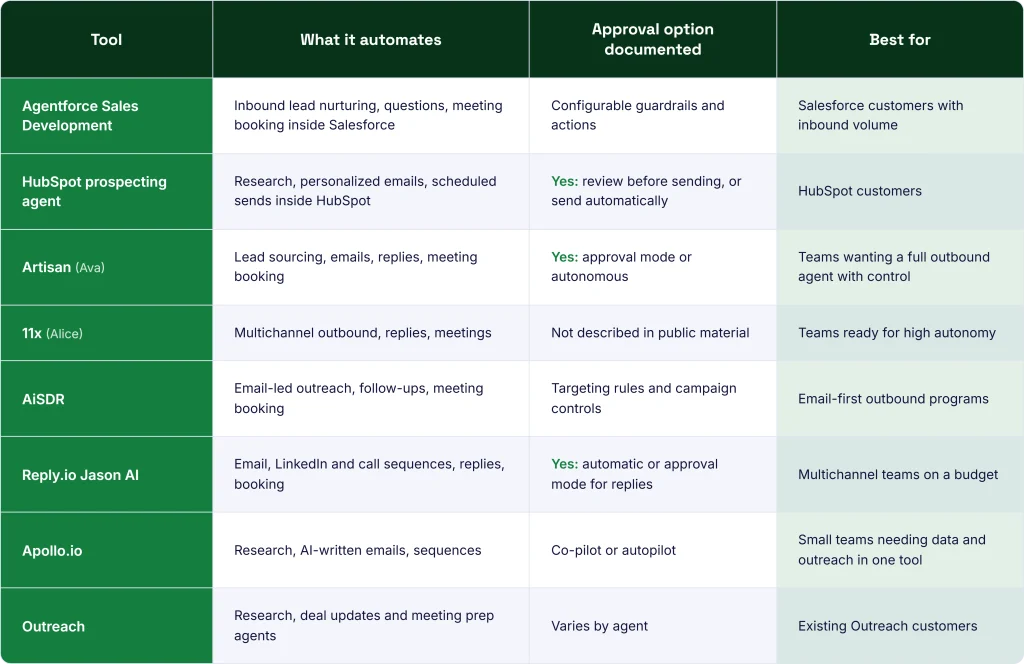
This guide compares eight AI SDR tools by what they automate and how much human control they keep, plus the email rules every one of them has to work within.
| Quick answer: The best AI SDR tool depends on how much you are willing to let it do alone. If you run Salesforce or HubSpot, start with the agent inside your CRM: Agentforce Sales Development or HubSpot’s prospecting agent. For dedicated outbound agents, Artisan, 11x and AiSDR are the main options, and Artisan and Reply.io both offer an approval mode. Lean teams get the most from Apollo. I do. Keep human approval on until meeting quality and spam rates hold steady. |
The 8 tools at a glance
What an AI SDR does, and what it still cannot do
An AI SDR is software that uses large language models to handle sales development tasks with varying levels of independence. Across the market, the tasks fall into five jobs:
- Find and research prospects
- Write personalised outreach
- Send and follow up across channels
- Handle replies and objections
- Book meetings on a rep’s calendar
What still needs people: judging whether an account is a real fit, running qualification calls, and working the multi-person buying groups behind most enterprise deals. AI SDR tools add capacity at the top of the funnel. They do not replace sales judgement.
The autonomy ladder
The most useful way to compare these tools is by how much they do without a person approving each step.
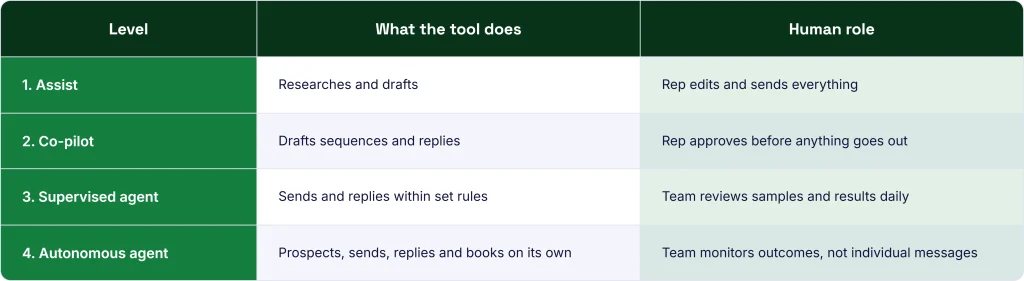
Most teams should start at level 2 and move up only when the data supports it.
The sending rules every AI SDR must follow
Whatever tool you choose, the big mailbox providers set the limits. All three now require authentication for high-volume senders, and each publishes clear thresholds.
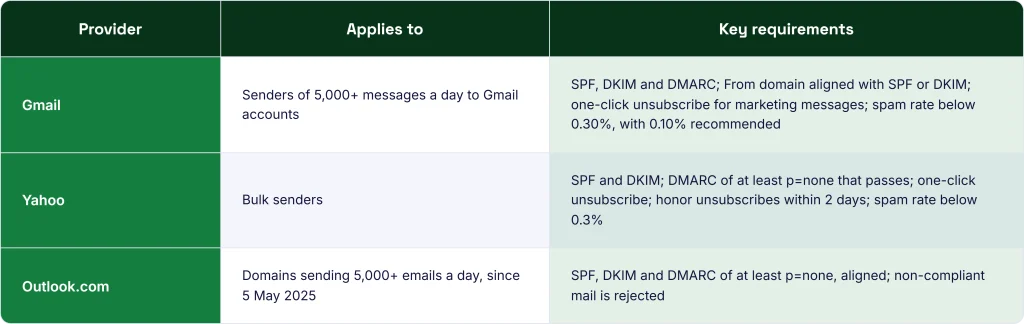
Sources: Google’s email sender guidelines, Yahoo Sender Hub and Microsoft’s Outlook announcement.
In practice, protect your main domain. Send AI SDR outreach from separate, warmed-up domains, cap daily volume per mailbox, and watch spam complaints in Google Postmaster Tools every week. Cold outreach is also governed by privacy and marketing laws that differ by country, so check the rules for each market you target.
How we compared the AI SDR tools
We reviewed each vendor’s public product pages and help documentation, checked on 7 October 2026. This is a documentation-based comparison, not a test of reply rates or meetings booked. Vendor performance claims are not included because they cannot be compared fairly. We looked at:
- Which of the five jobs each tool covers
- Whether it documents an approval or review step
- Channels supported
- CRM integration
- Data sources for prospects
AI SDR agents inside your CRM
If your sales team lives in Salesforce or HubSpot, the native agent is the lowest-risk place to start. Data, permissions and reporting already sit in one system.
Salesforce Agentforce Sales Development
Salesforce’s admin guidance describes an SDR agent that nurtures and qualifies inbound leads around the clock, answers questions and books meetings. Admins configure five things: the agent’s role, the Salesforce data it can use, the actions it can take, its guardrails and the channels it works in. It can engage leads in several languages and create follow-up tasks for sellers.
- Best for: Salesforce customers with steady inbound lead volume.
- Watch for: it is built around nurturing inbound leads; check the current packaging for outbound use with your account team.
- Pricing: part of Agentforce editions; confirm with Salesforce.
HubSpot prospecting agent
HubSpot’s prospecting agent researches enrolled contacts, writes personalised emails, schedules sends and tracks opens, clicks and replies. During setup you choose between reviewing and approving each message or letting the agent send automatically. It is available on the Starter, Professional and Enterprise tiers of several HubSpot hubs and uses HubSpot credits for each enrolment.
- Best for: HubSpot customers who want a clear approval switch.
- Watch for: credit consumption at volume.
- Pricing: included in eligible HubSpot plans, plus credits.
Dedicated outbound agents
Artisan (Ava)
Artisan’s Ava sources leads, writes personalised emails, handles replies and books meetings. The artisan says Ava searches a database of more than 250 million B2B contacts and adds signals such as hiring and funding. The most useful detail for risk control: campaigns can run in approval mode or send automatically, and Artisan describes both as settings rather than stages.
- Best for: teams that want a full outbound agent but need an approval step.
- Watch for: check how much of your existing data and messaging it can use.
- Pricing: quote-based.
11x (Alice)
11x offers Alice, an outbound agent that engages prospects across channels, handles replies and drives meetings, working across email, LinkedIn, phone, chat, SMS and WhatsApp. A second agent, Julian, handles inbound phone calls and meeting scheduling. Its public material focuses on independent operation and does not describe a pre-send approval step.
- Best for: teams comfortable with a high level of autonomy across many channels.
- Watch for: ask in the demo how messages can be reviewed before sending.
- Pricing: quote-based.
AI SDR
AiSDR is an email-led agent that researches prospects, writes personalised emails, sends follow-ups and books meetings. It uses signals such as website visits and social engagement to decide timing and integrates with HubSpot and Salesforce with two-way sync. Teams control it through targeting rules and campaign settings.
- Best for: email-first outbound programmes that want an agent to run sequences end to end.
- Watch for: it is primarily email; other channels are limited.
- Pricing: see the vendor’s pricing page.
Prospecting platforms with AI built in
Reply.io Jason AI
Jason AI runs multichannel sequences across email, LinkedIn and calls and books meetings against live calendar availability. For replies, it offers two modes: automatic, where it sends the AI response itself, or approval, where it waits for a person to confirm.
- Best for: budget-conscious teams that want multichannel outreach with a reply approval step.
- Watch for: set clear instructions and materials, since replies draw on them.
- Pricing: see Reply.io’s pricing page.
Apollo.io
Apollo combines a contact database of more than 240 million records with AI research, AI-written emails and an AI assistant that can run outreach and follow-ups. Apollo describes using AI as a co-pilot or letting it run on autopilot once you are ready.
- Best for: small teams that want data, sequences and AI in one tool.
- Watch for: confirm which AI features sit on which plan.
- Pricing: public plans on Apollo’s site.
Outreach
Outreach is a sales engagement platform rather than a standalone SDR agent. Its February 2026 release describes a Research Agent that refreshes account research on a schedule, a Deal Agent that can update opportunity fields automatically, and a Meeting Prep Agent in beta.
- Best for: existing outreach customers adding AI to rep workflows.
- Watch for: these agents support reps rather than replace prospecting.
- Pricing: quote-based.
A safe 90-day rollout plan
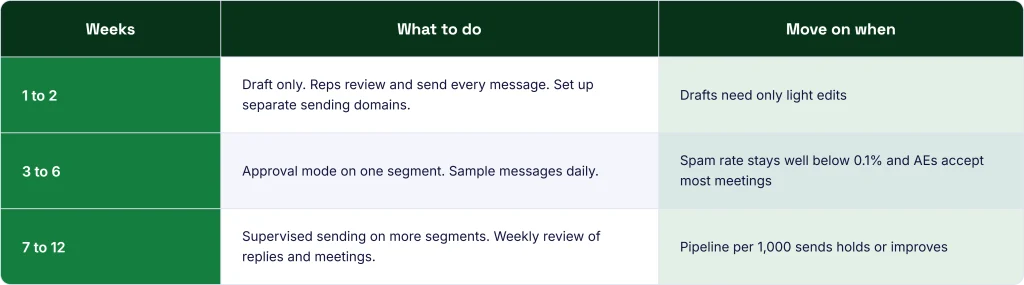
For more on running automation without losing the human side of selling, see our guide to smart sales automation. If you are still choosing a CRM, start with our list of the best B2B sales CRMs.
Common mistakes when rolling out AI SDR tools
Measuring meetings booked instead of meetings accepted
An agent can fill calendars with meetings that account executives decline or that never turn into opportunities. Count only meetings your sales team accepts, and track how many become pipeline.
Sending from the company’s main domain
If outreach from an agent triggers spam complaints, the damage reaches every email your company sends, including invoices and customer support. Keep agent outreach on separate domains from day one.
Skipping the message review phase
The first weeks are when an agent’s tone, claims and targeting need the most correction. Teams that switch straight to autonomous sending lose the chance to fix problems before prospects see them.
What to measure in the first 90 days
- Meetings accepted by account executives, not just meetings booked
- Pipeline created per 1,000 messages sent
- Positive reply rate, separated from total replies
- Spam complaint rate in Google Postmaster Tools
- Unsubscribe rate and domain reputation
FAQs:
Can an AI SDR replace human SDRs?
It can take over research, drafting and first-touch outreach, but most teams still need people for qualification, complex accounts and judging fit. Treat it as added capacity until your own results say otherwise.
Will an AI SDR hurt my email deliverability?
It can if it sends too much from your main domain. Use separate warmed-up domains, cap daily volume and stay within the Gmail, Yahoo and Outlook sender rules.
Which AI SDR tools let me approve messages before they go out?
HubSpot’s prospecting agent and Artisan both document an approval option for outreach, and Reply.io’s Jason AI offers approval for replies. Ask any other vendor to show you its review step in the demo.
How much do AI SDR tools cost?
Pricing for AI SDR tools ranges from features inside existing CRM plans to quote-based contracts for dedicated agents. Check each vendor’s current pricing page, since many changed models in 2026.
What is the difference between an AI SDR and a sales engagement platform?
A sales engagement platform runs sequences that reps build and manage. An AI SDR uses AI to do some or all of that work itself, from research to replies.