

Every Salesforce vs. HubSpot 2026 comparison eventually reaches the same conclusion: Salesforce is for enterprise, and HubSpot is for growth stages. That conclusion is correct. What most comparisons skip is the honest version of why, which is less about feature depth and more about what you are actually paying for and who carries the operational cost after the contract is signed.
Salesforce is the most capable CRM ever built. That is genuinely not in question. The question for most teams evaluating it in 2026 is whether the complexity it solves is the complexity they actually have and whether the organizational overhead it requires is overhead they can sustain at their current stage. Most companies under 200 reps answer no to both.
The Numbers First: What Salesforce vs. HubSpot 2026 Actually Costs
The license price is the number in the presentation. Total cost of ownership is the number in the operating budget.
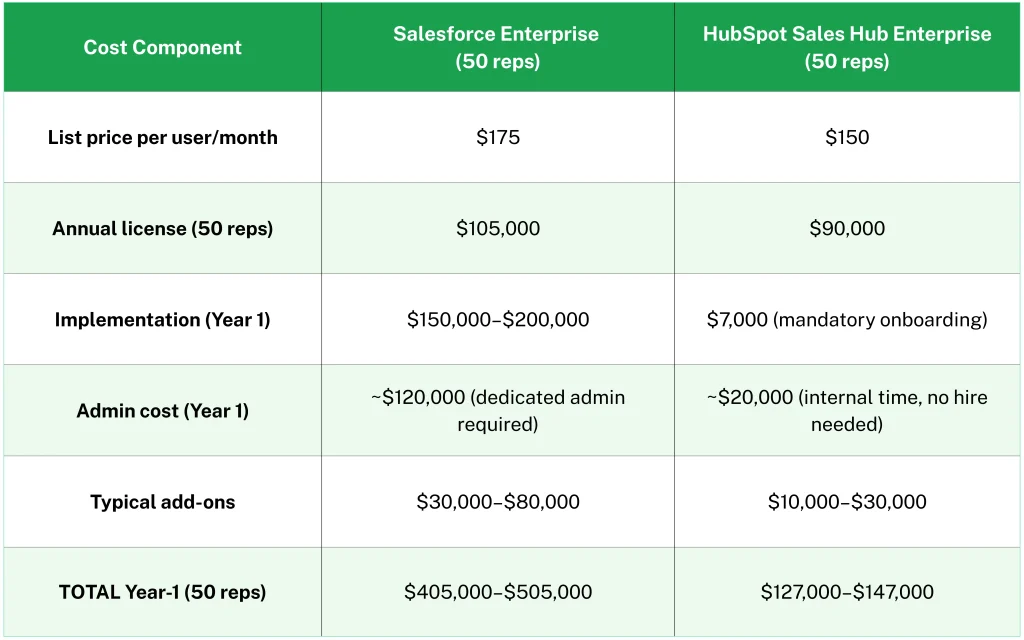
Three components explain the gap:
Implementation cost
Salesforce Enterprise implementations cost $150,000 to $200,000 because that is what proper configuration requires. Multi-org structure, territory and quota management, approval workflows, custom objects, AppExchange integrations, and training a population of users new to the platform. A Salesforce admin who shortcuts any of these produces a deployment that works for 90 days, then drifts. The implementation cost is not contractor margin. It is the work required to make the platform function.
HubSpot at the same rep count requires a mandatory $7,000 onboarding fee and internal team time. Operations are live in 6 to 12 weeks without external consultants.
Admin overhead
Salesforce requires a dedicated admin above 50 reps. There is no credible workaround. The platform’s power comes with configuration complexity that accumulates: outdated workflows, permission conflicts, and data model drift. Someone has to manage it full-time. That person costs $100,000 to $140,000 per year in most markets, and that salary appears nowhere in the license price comparison.
HubSpot’s configuration is maintained by an operations generalist who also handles other work. Most teams under 200 reps do not need a dedicated HubSpot admin.
AppExchange costs
Salesforce’s 5,000+ AppExchange integrations are a genuine advantage. They are also frequently paid. Sales engagement tools, revenue intelligence platforms, document generation, and territory management that ship in HubSpot’s native stack often require AppExchange licenses in Salesforce. These costs accumulate across departments and rarely surface in the initial procurement conversation.
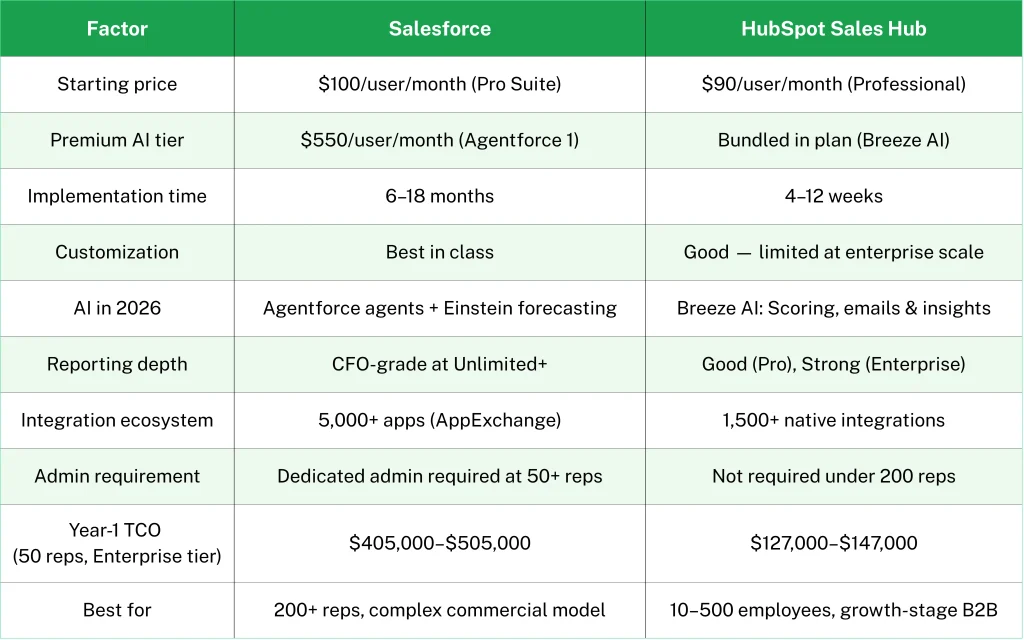
The Side-by-Side
The Capability Argument for Salesforce
Commercial model complexity
If your sales motion involves multiple products with different discount structures, multiple segments with different contract terms, channel partners with deal registration, or government contracts with compliance overlays, you need Salesforce. HubSpot’s data model is not built for this complexity, and no creative HubSpot configuration replicates Salesforce’s commercial model depth. Teams that try to model complex commercial structures in HubSpot build manual workarounds that become technical debt and eventually require a migration.
CFO-grade forecasting
Salesforce’s forecasting holds up to CFO scrutiny: multi-currency rollups, segment-level overrides, and AI-adjusted confidence bands via Einstein. For public companies and large private ones reporting quarterly pipelines to boards, this matters in ways HubSpot’s reporting does not match. Attempting to build public-company-grade forecasting in HubSpot typically requires a third-party revenue intelligence tool like Clari or Gong, which narrows the total cost gap.
Compliance and regulated industries
Financial services, healthcare, government, and life sciences have compliance requirements that Salesforce has spent 25 years building into its infrastructure. Health Cloud, Financial Services Cloud, and Government Cloud are not just Salesforce with a different name. They are compliant data models and audit architectures that would take years to replicate. If your compliance team reviews CRM architecture as part of vendor risk assessment, Salesforce is usually the answer before the technical evaluation begins.
The Capability Argument for HubSpot
Time to revenue impact
HubSpot is operational in 4 to 12 weeks. Salesforce at the enterprise tier regularly runs 6 to 18 months from contract signing to full rep productivity. For a growth-stage company with quarterly targets, 12 months of CRM construction is not just an inconvenience. It is a compounding strategic disadvantage. Every month without a functioning CRM is a month of pipeline data and activity history that does not exist when you need it for forecasting and performance review.
Breeze AI without a separate AI tier
HubSpot’s Breeze AI ships inside the standard plan. Lead scoring, deal insights, email drafting, and meeting prep are included at Professional and Enterprise without a separate license. Salesforce’s Agentforce 1 at $550/user/month delivers more capable autonomous agents. But most teams under 200 reps do not need autonomous CRM agents—they need useful AI assistance in the workflow they already use. HubSpot delivers that at no additional cost.
Rep-level adoption
CRM value is a function of CRM adoption. A CRM that every rep updates daily is worth more than a more powerful CRM that reps work around. HubSpot’s interface is modern, fast, and non-threatening to reps who did not grow up on Salesforce. New rep onboarding for HubSpot takes hours. For Salesforce at the enterprise tier, it takes weeks. That adoption gap compounds into data quality differences, pipeline visibility differences, and forecast accuracy differences that are harder to measure than the license fee but are equally real.
The Question Most Teams Skip
Before choosing between Salesforce vs. HubSpot 2026, ask this: Who will own the CRM after it is live?
HubSpot’s answer: an operations generalist, a marketing operations person, or a RevOps lead who manages multiple tools. No dedicated full-time focus required under 200 reps.
Salesforce’s answer: a certified Salesforce admin or admin team. This is not optional at scale. It is the operational requirement that makes the investment sustainable. Teams that choose Salesforce without a credible admin plan consistently end up in one of two places: a Salesforce installation that is technically live but practically abandoned (reps track deals in spreadsheets), or a six-figure Salesforce partner engagement three years later to rebuild what should have been built correctly at the start.
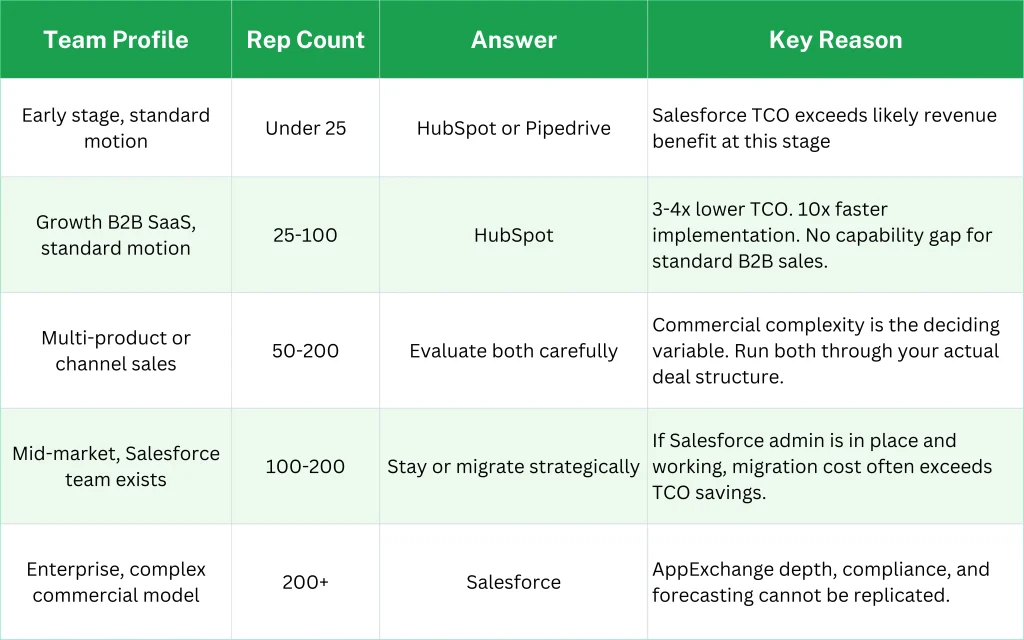
Who Should Choose Which
Final Verdict on Salesforce vs. HubSpot 2026
The Salesforce vs. HubSpot 2026 answer is clear for the majority of mid-market teams: HubSpot until the complexity proves otherwise. Not because HubSpot wins a feature competition, but because the 3x to 4x total cost premium for Salesforce needs to buy something specific. That something is complex commercial model support, enterprise compliance architecture, or forecasting depth that holds up to CFO scrutiny. If the current commercial model does not require those things, Salesforce’s cost premium buys platform capability that will not be used.
The teams that regret choosing HubSpot usually outgrew it—which means they grew. The teams that regret choosing Salesforce usually never needed it—which means they paid for someone else’s complexity. Regret the former. Avoid the latter. For the full CRM market picture, see the best B2B sales CRMs in 2026.
FAQs:
Salesforce vs. HubSpot 2026: Which CRM is right for a 100-rep team?
Standard sales motion: HubSpot Sales Hub Enterprise, at roughly 3x lower TCO. Complex territories or multi-product deals: start evaluating Salesforce.
What is the real Year-1 cost difference in Salesforce vs. HubSpot 2026?
For 50 reps at Enterprise tier: Salesforce runs $405K–$505K vs. HubSpot’s $127K–$147K, mostly from implementation and admin overhead, not license price.
Can HubSpot handle 150 reps?
Yes, for standard one-buyer, one-contract deals. Complex commission splits or channel partner structures hit limits before 200 reps.
What should I ask Salesforce before signing?
Get the fully loaded year-1 cost, exact implementation scope, and the contractual renewal cap—most auto-renew at 7–12%.
Which platform has better AI in 2026?
Salesforce Agentforce 1 ($550/user/month) is more capable; HubSpot Breeze is bundled free and sufficient for most teams under 200 reps.